
The first question on a retrofit walk is which screws are backing out. An exposed-fastener metal roof is held down by thousands of screws with rubber washers, and the washers harden long before the steel gives out. For a property manager with a flex, storage or light industrial building off MO 291 or US 50 near I-470 in Lee's Summit, MO, the first sign can be a few drips near a loading door. The work that follows has a set order: tenant notice, access to the roof, a fastener and seam survey, a decision between restoring and recovering, and a handoff with the paperwork.
We walk the panel field in a pattern and mark each failed detail. Backed-out screws, stripped holes, split washers, rust at laps, open sealant at ridge and eave, and panels that have lifted at the end laps all get a photograph and a position on the roof drawing. Walking on a corrugated roof is also a safety matter, so we step on the purlin lines and avoid mid-span crossings.
Underneath the panels, the insulation or the building interior shows what the water has been doing. Stains on the ceiling grid, rust on the underside of the sheet and wet batt insulation tell us whether the roof can be restored in place. A drone pass picks up panel waviness and fastener patterns across a large span before a crew sets foot on the roof, and infrared scanning at dusk can find damp insulation in buildings that have it. The written report sorts the roof into areas that can be restored and areas that should be recovered or replaced.
Penetrations get their own pass. Pipe boots, skylight curbs, gutters and ridge vents each carry a different failure pattern, and the report lists them one by one with the repair that fits. A cracked boot is a small repair, while a curb that has rusted at its base may need new flashing around the full perimeter, so these items are priced separately from the field work.
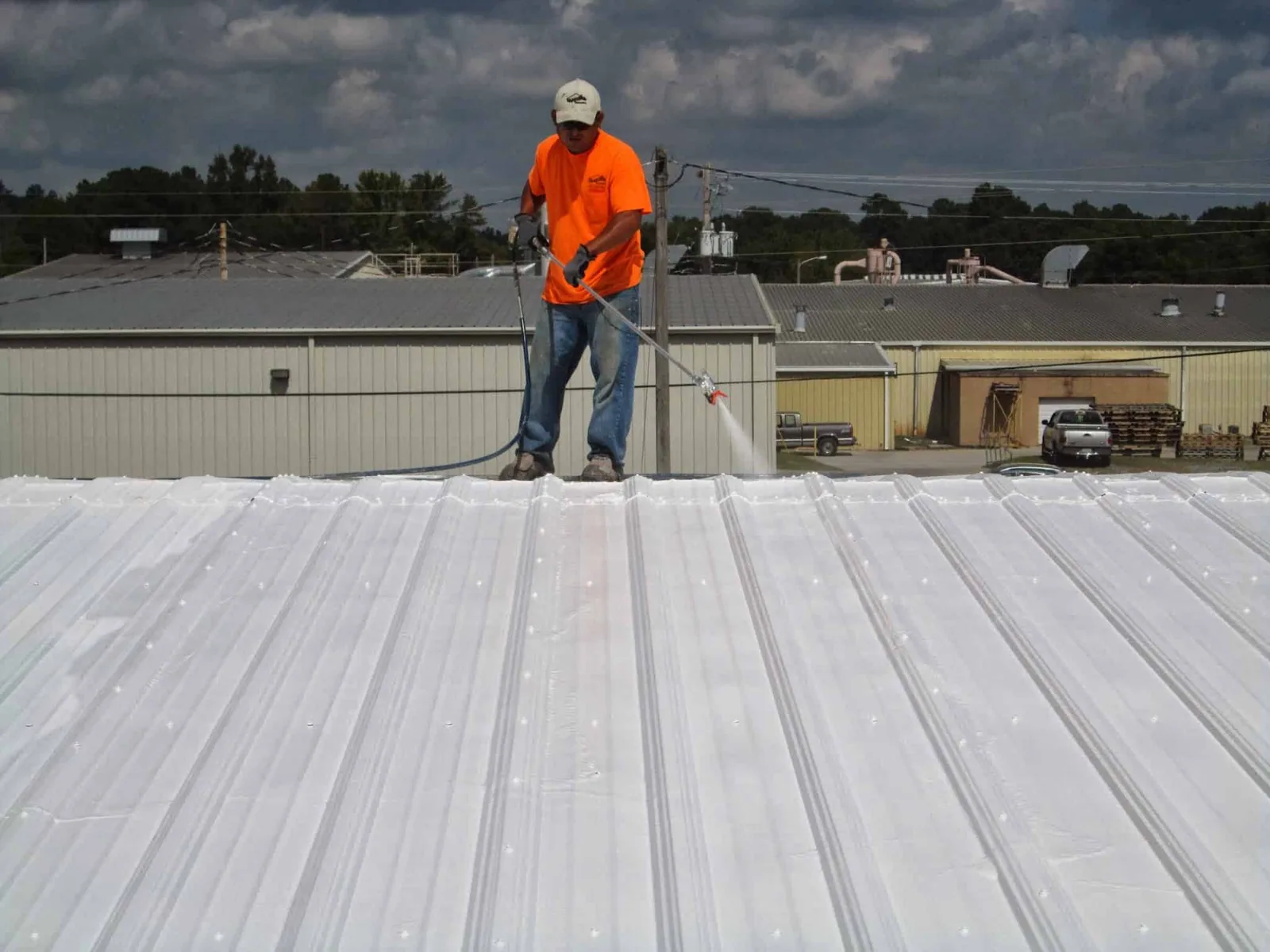
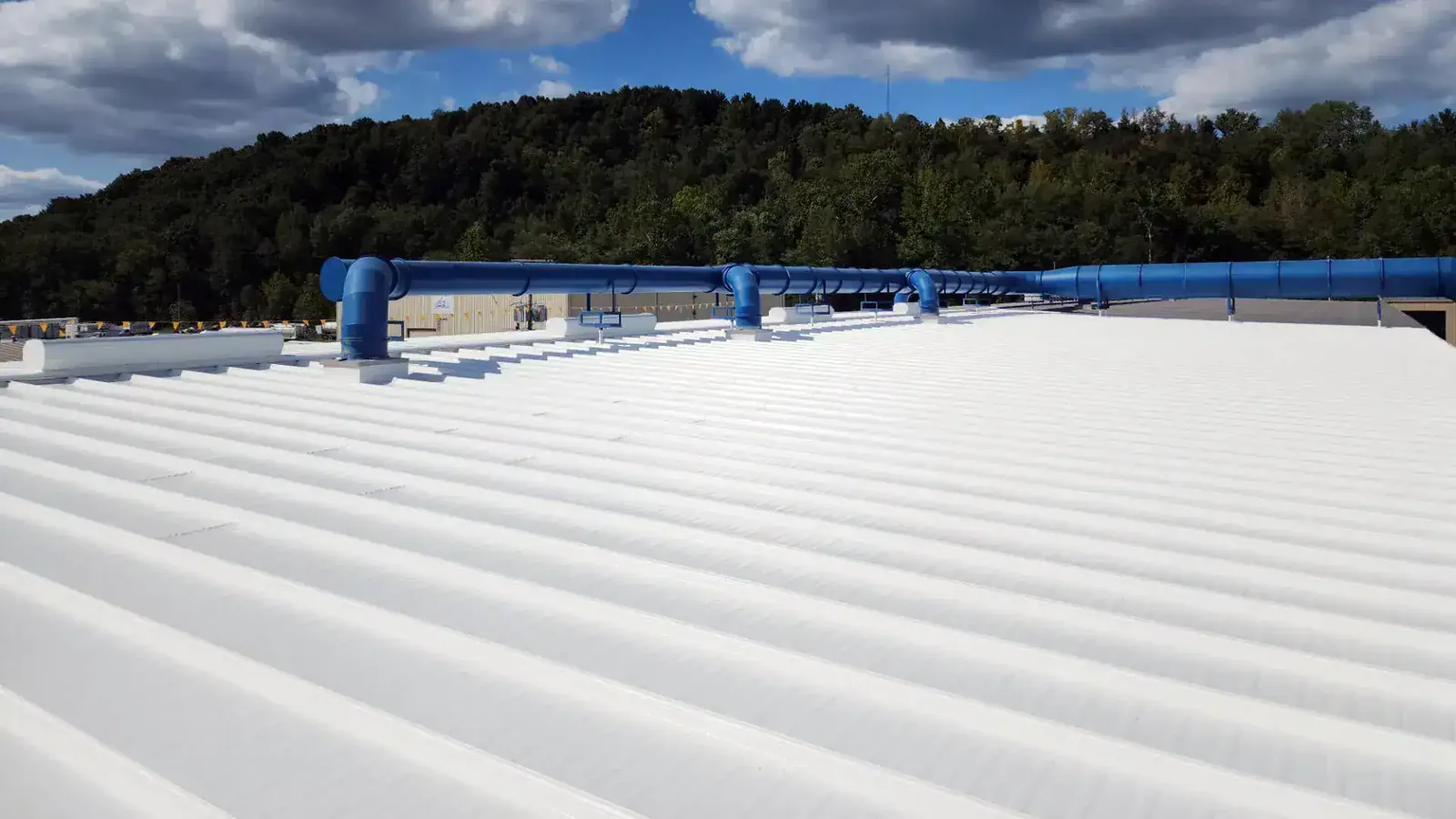
Restoration is the lowest-disruption path and fits a roof whose panels are structurally sound. The steps run in order. First, loose and failed fasteners are replaced with larger-diameter screws or ones with better washers. Next, laps and penetrations are sealed with compatible sealant and reinforcing fabric. Then the whole surface is cleaned, rust is treated, and a fluid-applied coating is rolled or sprayed over the field.
The coating is chosen against the panel finish and the drainage. A silicone coating tolerates standing water at low spots, while an acrylic coating is a lighter-cost option for roofs that drain freely. Adhesion testing on a small patch comes first, because a coating that does not bond to old paint peels the next season. Weather decides every day of this work, so the weather hold rule covers temperature and dew point as well as rain.
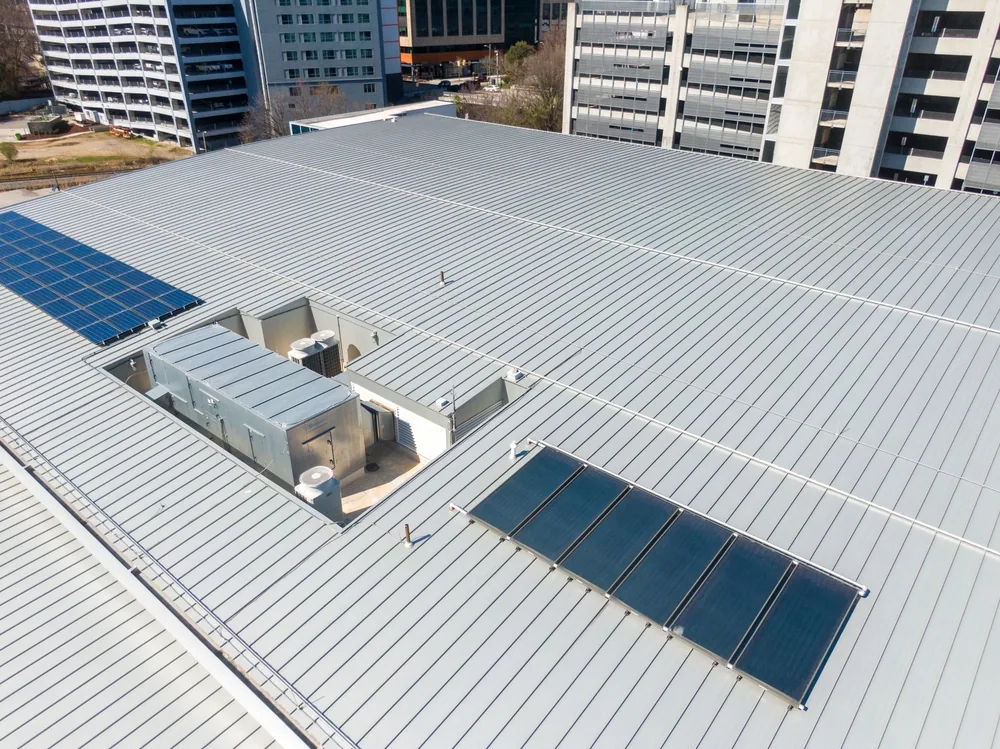
When the panels are rusted through or the structure is moving, a recover installs a new metal roof on a framing system above the old one. Subpurlins or a hat-channel grid span the old ribs, insulation fills the gap, and new panels, often with concealed clips, go on top. The building stays occupied, because the old roof acts as a temporary cover while the new one is installed. A standing seam panel is a common finish for this route.
The structure has to carry the extra weight, and the framing connections to the old purlins must be checked before the order is placed. Code questions follow the submittal date. Which I-Codes edition applies in Lee's Summit turns on the permit submittal date, so the timing is worth confirming early.
Spring work runs against the storm calendar. The April 27, 2024 warning from the National Weather Service for Lee's Summit mentioned 60 mph gusts, penny-size hail and roof damage. Open panels and loose screws are the first casualties in wind like that, so each section is buttoned up before the crew leaves, and no loose sheet stays on a roof overnight.
Winter has its own demands. Cold steel pulls fasteners tight while warm days relax them, and the range here runs from a record low of -25F to a July mean high above 88F. Sealant has a minimum application temperature, and coatings need a dry, warm surface to cure. Cold-season restoration is limited to jobs that can stay under those limits, and the plan lists which scope waits for spring.
A metal roof of this type often covers a building that keeps operating through the work. A warehouse bay has forklifts under the same panels that need new screws, and a flex building has a tenant who cannot lose power for a day. We schedule the noisiest operations for hours that suit the occupants and rope off the ground below each work zone. Dock and entry hours set the delivery times for materials, and the lift location is picked so no door is blocked at noon.
Interior protection can matter on an exposed-fastener roof, since removing a panel exposes the space. Panels come off only when the replacement is staged and ready to set, and the interior below is covered or cleared first. A tenant notice names the work zone for each day and the hours the crew will be overhead. Thorough occupied building reroofing planning keeps tenants informed of each phase boundary and each day's end condition.
At turnover the property manager receives the roof drawing with the repaired and coated areas marked, photographs of each detail, the product data for the sealants and coatings, and a punch list marked complete. We recommend a walk after the first spring storm window, since a retrofit's first test is a hard rain with wind. The record for the roof begins with that package, and a preventive maintenance schedule for the sealant and fasteners keeps the restored roof tracked after the work ends.
An owner in Lee's Summit comparing restoration with replacement will find the cost line in the report: restoration on sound panels, recover on tired ones, and replacement where the deck and structure are failing.
Daily thermal movement works them loose, and the rubber washers age in UV and heat. Lee's Summit has an 88.3F July mean high, so a roof over a warehouse bay is stressed every summer.
Restoration costs less up front when panels are sound. A recover costs more and removes the screw-and-washer problem permanently, so the panel condition and the owner's holding period decide.
Surface rust is cleaned and treated before coating, and the coating then seals it from moisture. Rust that has eaten through the steel needs panel replacement, which the survey marks.
A small test patch is cleaned, coated and checked for adhesion after it cures. A peel test on that patch decides whether the full roof gets a primer first.
Fastener replacement and mechanical repairs can continue in cold weather. Sealants and coatings wait for the temperature and dryness limits on their data sheets.
Send the building address list, tenant hours and any open leak reports. We will walk the roof with the property manager and return a written sequence plan for the retrofit before any scope is priced.
Request a Roof Assessment