
Shift hours, dock traffic and rooftop exhaust set the sequence for roof work in Grandview, MO. The city lies along US 71 on the southern border of Kansas City, in Jackson County, and the Grandview Triangle, where I-435, I-470 and US 71 meet, has received highway improvements. Employers listed in the city's 2016 financial report include Peterson Manufacturing, Mead Westvaco Calmar and Ruskin Company. Roofs over manufacturing and commercial space are worked around the people and trucks on site, and we start by learning which of those the building cannot interrupt.
The access route and the dry-in point are drawn at the first site walk.
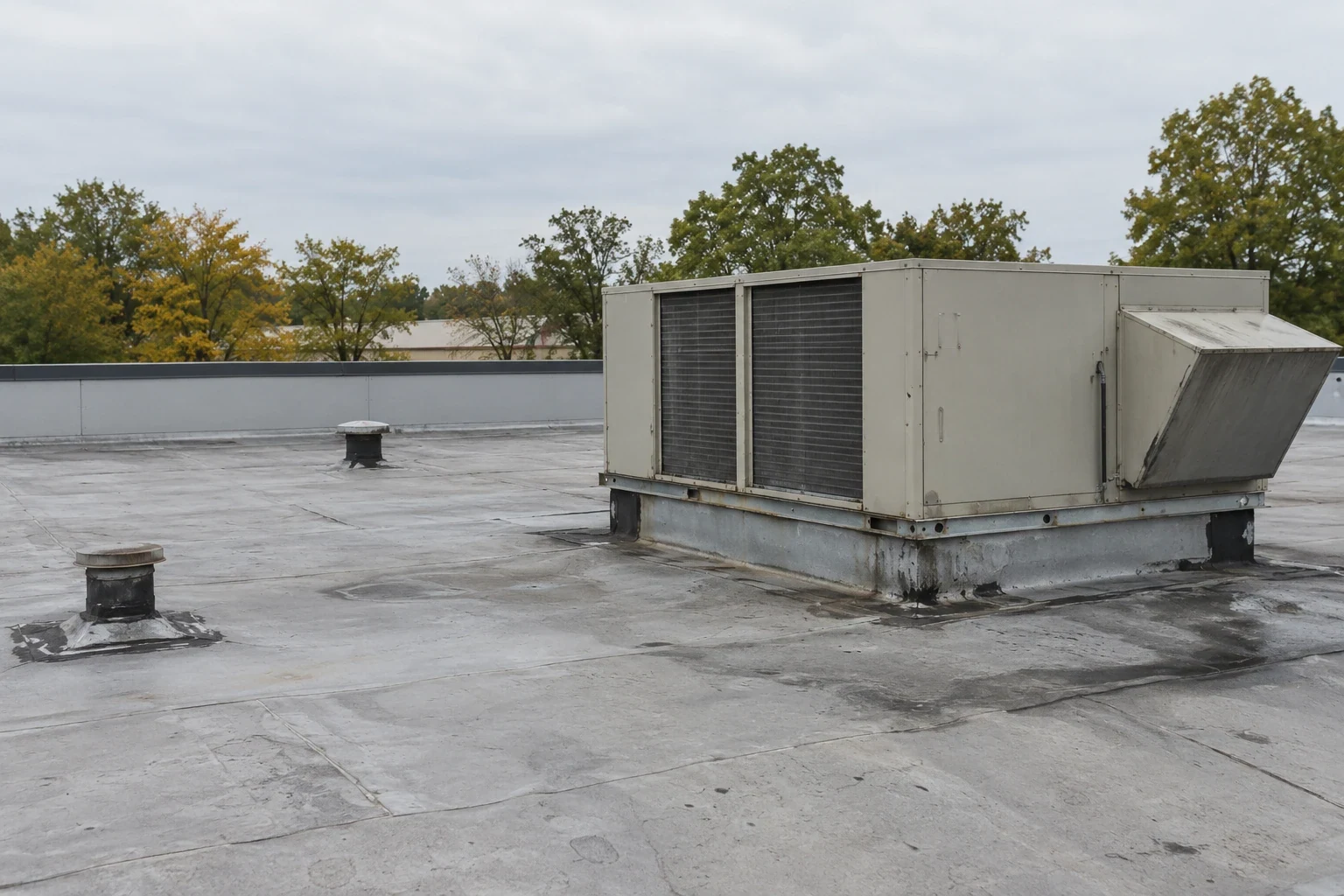
A manufacturing building often carries more on its roof than an office: exhaust fans, make-up air units, dust collectors, process vents and long runs of conduit. Each penetration is a flashing, and each flashing sits in a spot that gets maintenance traffic. We survey and map all of it before a membrane is chosen.
Chemical and heat exposure from exhaust can attack some membranes, so the walk looks for staining, softening and ponding near discharge points. Before specifying, we ask the facility manager what the units discharge. A manufacturing plant roof needs that answer as much as it needs a drawing.
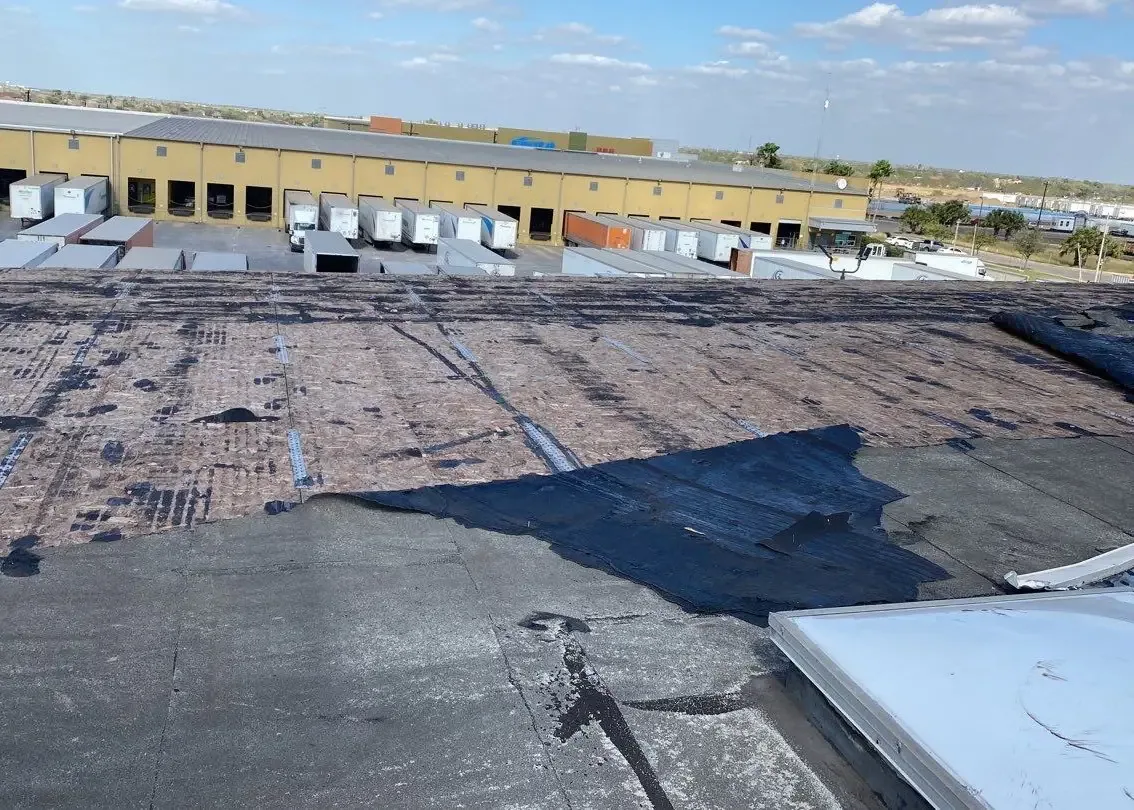
Repairs follow what the survey finds. Abandoned curbs and capped lines are removed and the opening patched with new deck and membrane. Loose conduit is supported so it stops rubbing through the sheet, and walkway pads go down where technicians cross. A roof with several of these defects and wet insulation under them may be better replaced than patched, and the condition report lays out both costs side by side.
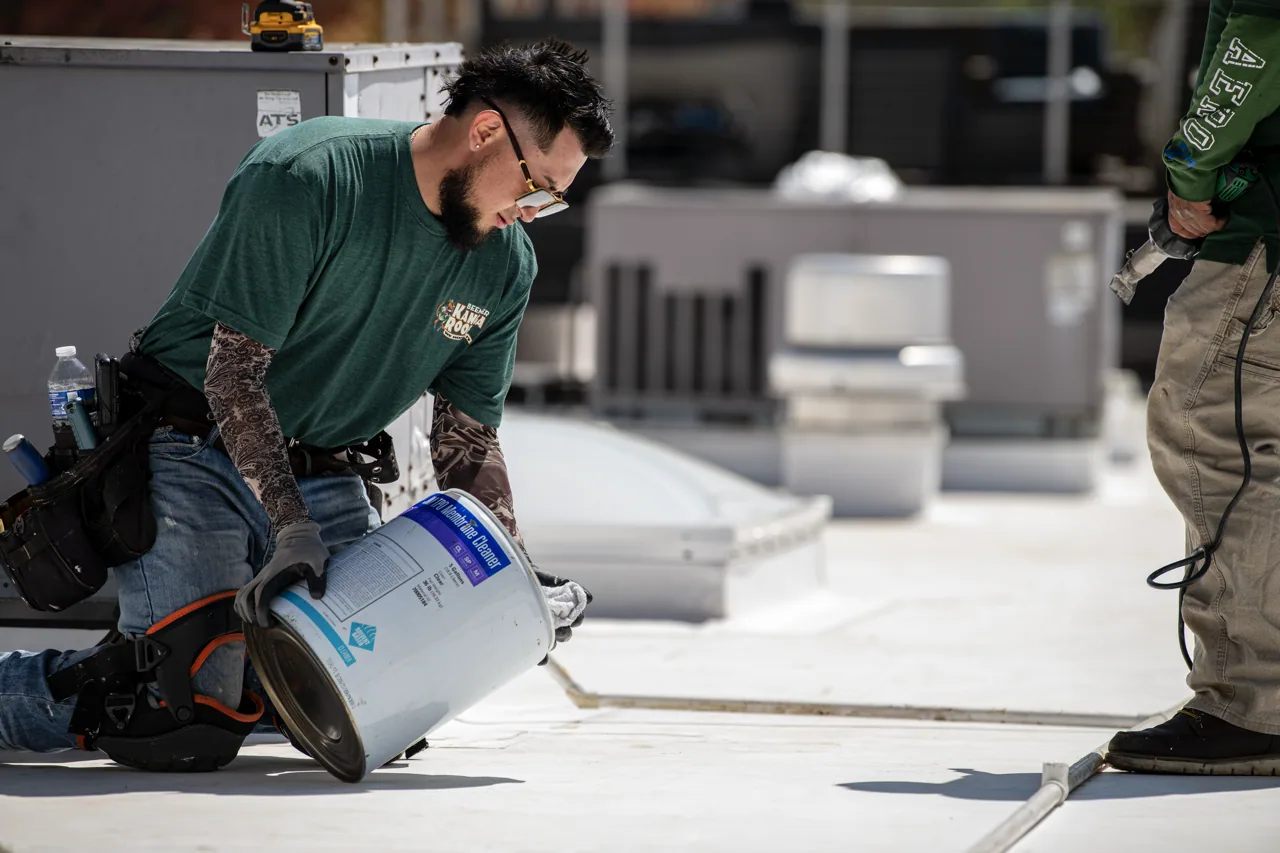
Where employers run more than one shift, roof work is planned around when people are on the floor. Noisy tear-off and fastening are scheduled for the hours the manager picks, and any interior area under the work is protected with covers or temporary shields. The crew coordinates with the plant's safety rules, including badging, lockout around equipment and walking routes on the roof.
Staging uses the least-used part of the lot, and delivery of insulation and membrane is timed so trucks do not meet shift change. If a unit must be shut down to be lifted, the outage is arranged with the plant's maintenance staff in advance, since a surprise shutdown costs far more than the roofing item that caused it.
Weekend and holiday work is sometimes the right answer for a plant, and emergency response is available around the clock if a section opens in a storm. In that case a temporary seal is placed first, the interior is protected and the permanent repair is scheduled once the weather and the plant's calendar allow.
Grandview's position at the junction of I-435, I-470 and US 71 makes it easy to reach from other parts of the metro, which helps with trucks bringing materials and crews moving between sites. Heavy loads still have to get from the highway to a particular dock or yard, and that last stretch needs planning.
We map the route from the ramp to the building, check turning room for a flatbed, and place the hoist where it will not block a loading court. Where a building shares a lot with neighbors, the property manager helps coordinate the days we occupy part of it. Owners with buildings in Grandview and Lee's Summit can run one schedule across both.
Grandview's northeastern side took the 1957 Ruskin Heights tornado, an F5 that killed 44 people on its path through the southern suburbs of Kansas City. Wind is a design issue for roofs in this area, and the attachment pattern is chosen with that in mind.
No membrane is designed to survive a tornado, but most wind damage begins at corners and perimeters where uplift is highest. A roof in this area is attached with tighter fastening at those zones, and edge metal is secured to resist peel. After any wind event, a tornado damage roof repair walk starts at the perimeter and works inward, photographing lifted edge metal, torn laps and displaced equipment.
Nearby Lee's Summit takes in about 38 inches of precipitation in a year, with mean highs of 39F in January and 88F in July. Its record range runs from -25F to 108F. Seams, flashings and sealants on a Grandview roof see the same kind of swing, and spring storms test them.
A National Weather Service warning on April 27, 2024 named Lee's Summit and carried 60 mph gusts and penny-size hail. We schedule repairs in March when we can, and open sections carry a weather hold rule through spring. A planned roof repair list completed before the storm window costs less in labor and disruption than the same work done after a night of rain through a ceiling.
The turnover package lists what was opened and closed, with the roof drawing, dated photographs, product data and a list for the next walk. For a plant with many rooftop units, the package also records each curb, each boot and each discharge point, with photographs taken before the membrane covered them, so the next time equipment is replaced the roof drawing is accurate.
Follow-up walks after the first season check terminations, seams and drains, and the findings roll into an ongoing roof asset management record. For owners with property in Belton or elsewhere, the same format applies.
The work is split into phases that never leave a section open overnight, noise is placed in the hours the manager chooses, and interior areas under the work are protected. Equipment outages are scheduled with the plant's maintenance staff ahead of time.
We ask the facility manager, then check the roof for staining, softening and ponding near each discharge point. If the answer is uncertain, a test patch on the membrane shows how it reacts. The membrane choice follows from that, before any order is placed.
It reminds owners that perimeter and corner uplift matter. The design numbers come from the building's height and exposure, and attachment is tighter at corners and edges. Edge metal is fastened to resist peel, and the details are shown on the drawings. Pull tests on a sample of fasteners confirm the deck holds what the design assumes, which matters on an older building where the original attachment is not documented.
The property manager and our site lead agree on the days, hours and locations, and the plan names them in writing, along with who answers the phone on site each day. If a neighbor needs a dock, the hoist moves. The notice to each tenant says which part of the lot is affected.
As soon as it is safe. A walk within days finds bruising, split seams and lifted edge metal before a second rain enters. Dated photographs show the building's condition and give an insurer the facts, and open areas are sealed with temporary measures at once.
Share the building addresses, shift hours, rooftop equipment list and any leak reports. We will walk the roof with the facility manager and return a written sequence plan before any scope is priced.
Request a Roof Assessment