
Harrisonville, MO is the Cass County seat, and its commercial roofs sit in two settings that call for different plans. Buildings in and around the Courthouse Square Historic District call for a careful notice, a short staging lane and an exterior that looks the same when the crew leaves. Buildings along US 71, Missouri Route 2 and Missouri Route 7 need a truck route, a roll-off position and a clear entrance for customers. Either way, the order is the same: notice, access route, staging, and then the roof condition that decides the first section.
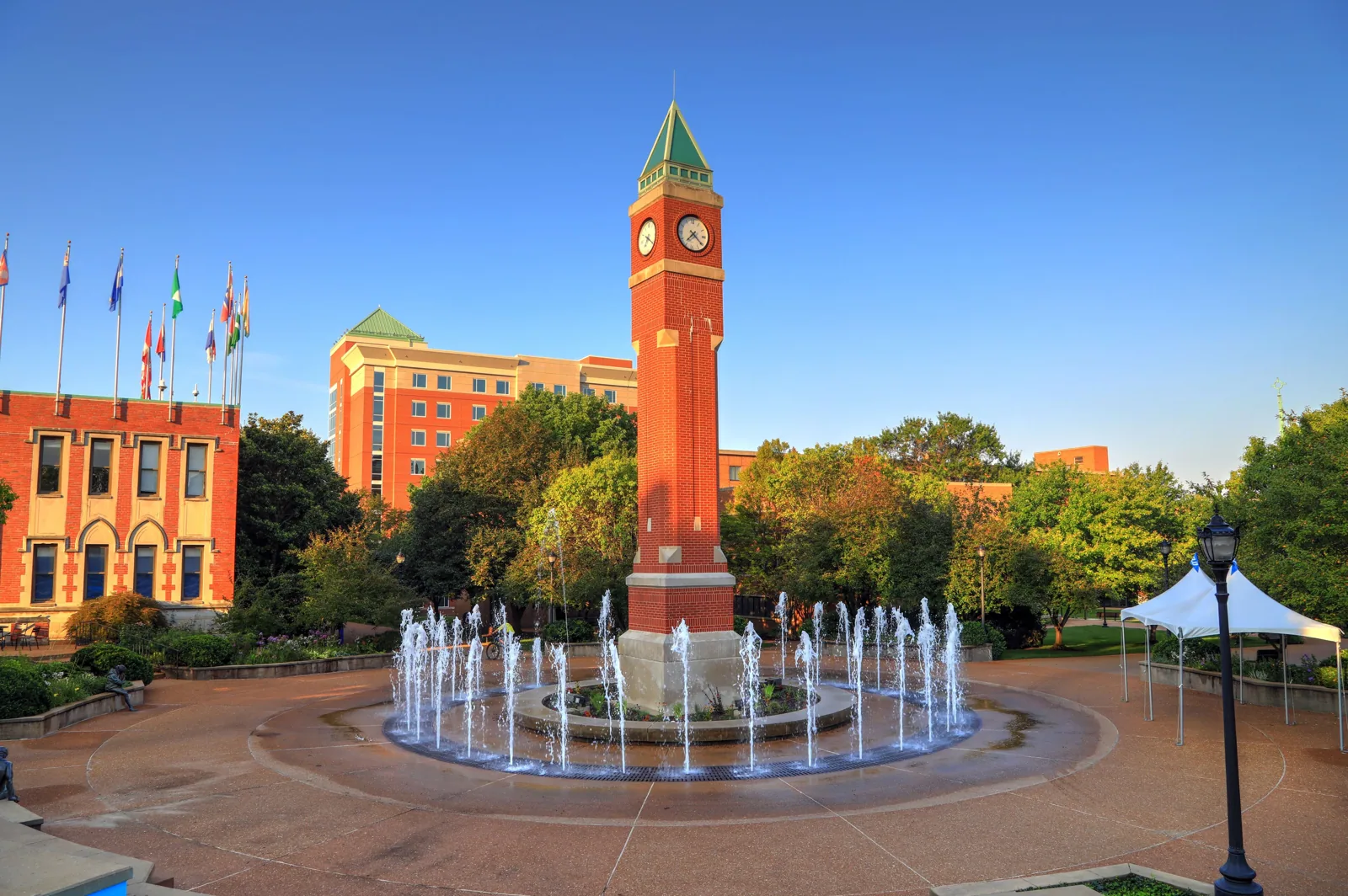
The Courthouse Square Historic District is listed on the National Register of Historic Places. Each building is read on its own, and we ask the manager whether the owner needs to coordinate exterior work with the city before it starts. Where a parapet or coping line can be seen from the street, the plan describes how the finished edge will look.
Along the highways, the picture is different. US 71, Route 2 and Route 7 intersect in the city, and frontage lots are often wide, with room for a hoist and a container. We still mark the staging footprint away from customer stalls and any receiving door, and the notice tells tenants which entrance is closed and when.
Delivery timing on a square is tighter than on a highway lot. Courthouse business, parking and pedestrians set the busy hours, so trucks arrive before they build, and the hoist is lifted early. If a street must be partly closed, the manager and the city are asked first, and the date goes on the notice. A tenant should never learn from a flag on the sidewalk that a lane is blocked.
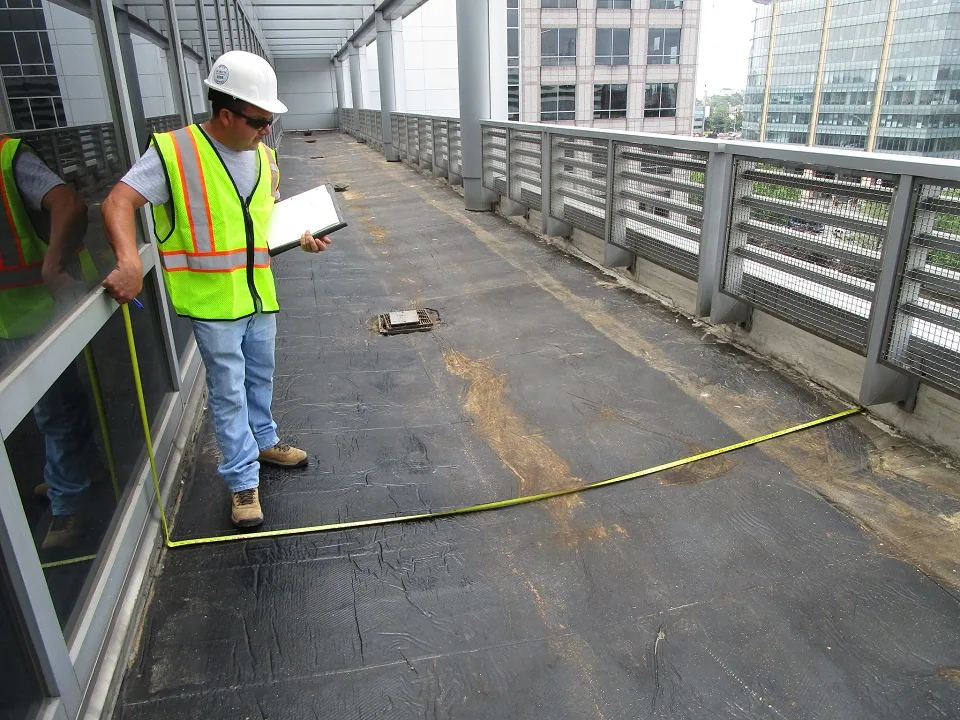
The first walk records water paths before anything else. Drains and scuppers, ponding rings and soft spots show where a low-slope roof is losing. Seams, laps and flashing at walls and curbs show where the membrane is moving. Parapet walls and coping show whether the perimeter is sound.
Where a building shares a wall with its neighbor, the flashing at that shared wall gets extra time, since a leak there can travel into both spaces. Photographs are marked on a drawing, and any interior stain is traced along the deck. A commercial roof inspection done this way gives the manager a record to compare with the next visit.
Interior signs complete the picture. Ceiling tiles with fresh stains, a wall that stays damp near the roofline and a door that sticks after rain each point to a path. We trace from the sign up to the roof and note the distance between them. A leak that surfaces in one suite often starts above the next, and the drawing shows both.
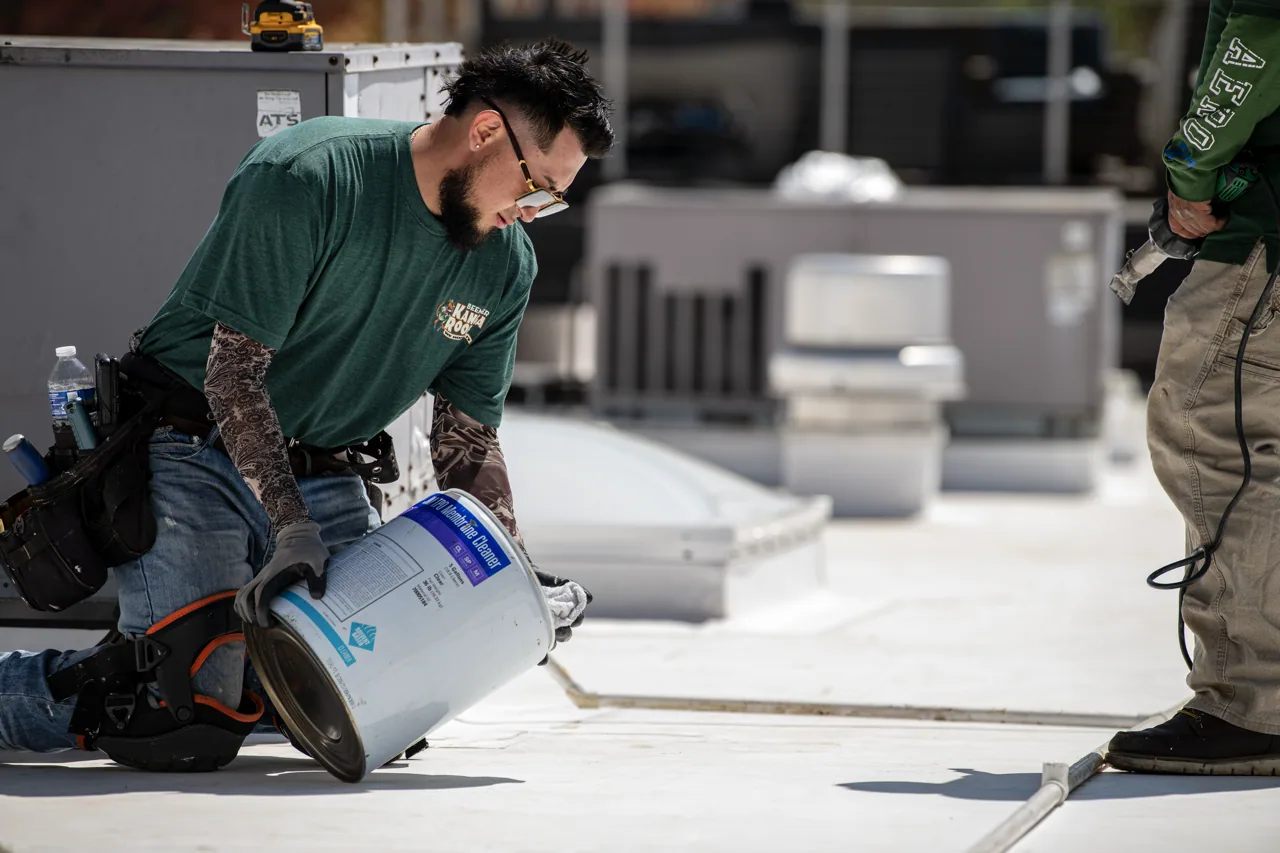
The work opens one section at a time. Day one covers the walk, the notice and the setup. Day two opens the first section, and it is dried in before evening. Tie-ins to the next section or to an adjoining roof are sealed at the end of each day, and a drawing shows which areas are open on which date.
On a row of shared-wall buildings, the order is agreed with each owner so that no tenant is surprised by a crew on a neighbor's roof. The plan lists each notice date, the hours of loud work and the order of handoffs. A short commercial roof repair uses the same notice and a lighter plan.
If a section has to be left overnight, it is left with a temporary seal that has been tested with a hose. The foreman notes the seal in the log with a photograph, and the first task the next morning is a check of that seal before new work starts. That one habit prevents most overnight leaks on phased jobs.
Lee's Summit, close by, measures about 38 inches of precipitation across a year, and its April 27, 2024 National Weather Service warning named damage to roofs from penny-size hail and 60 mph gusts. The F5 Ruskin Heights tornado of 1957 killed 44 people, cutting a path through the southern suburbs of Kansas City. Those events frame how the spring plan is written.
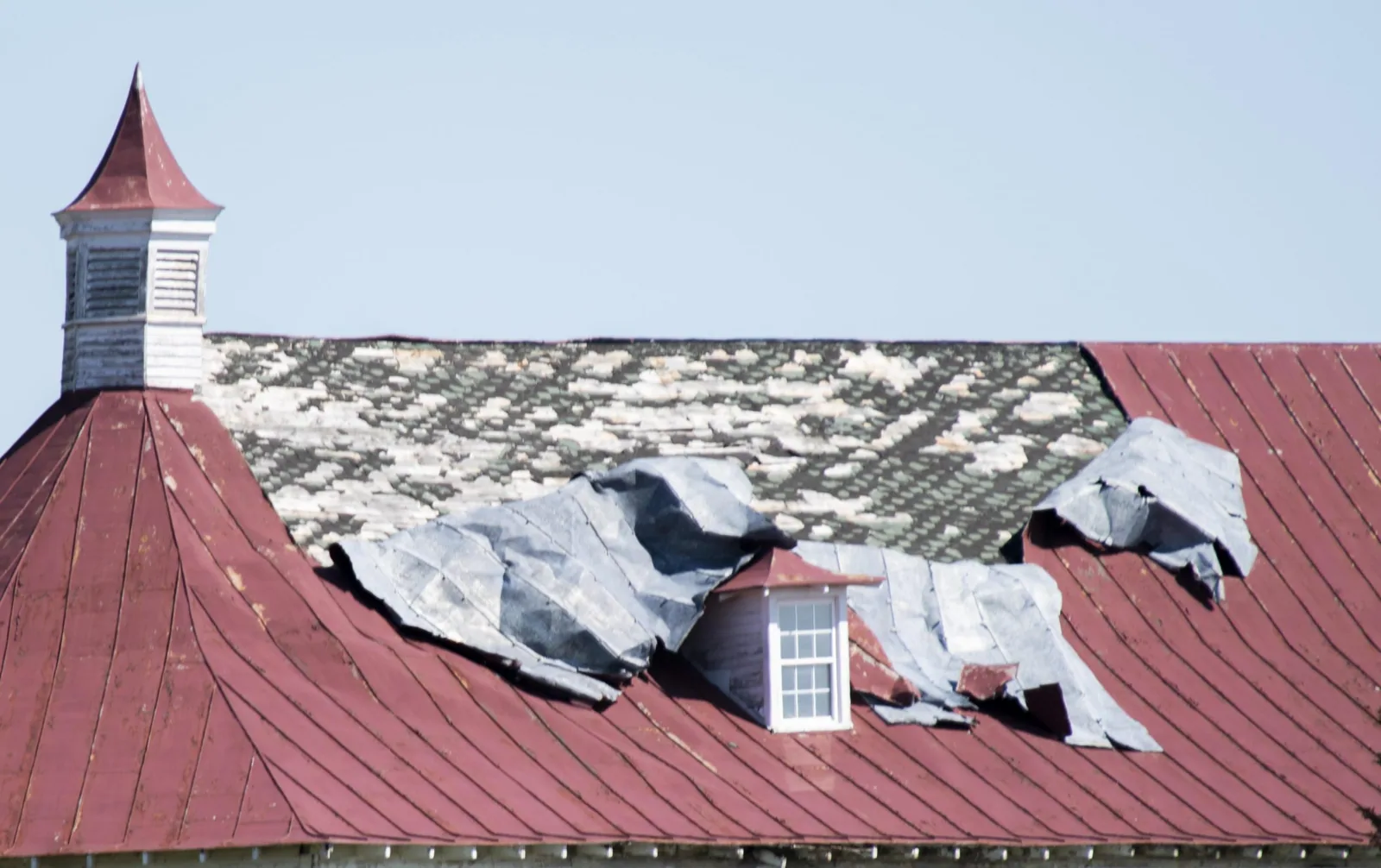
When a storm line is forecast, a hold rule halts the work at the next safe point. The open section is sealed, material is secured and the manager is told. After a storm, a walk of the perimeter, the coping and the curbs comes first. A wind damage finding is photographed, secured and priced before the next rain.
Cold and heat matter too. Winters in Lee's Summit reach a mean high of 39F and summers 88F, with the record low at minus 25F and the record high at 108F. The 2002 ice storm knocked out power across Kansas City, and hundreds of thousands of people waited days or weeks for it to return. Roofs in this region move, freeze and bake, and the repair materials are chosen for that range.
Parapet walls complicate dry-in because water can enter behind coping or at the wall flashing, not only at the field. We seal those details before the end of the shift, and a temporary termination is labeled as temporary in the log. If the forecast changes, the area that is open shrinks.
Debris leaves by chute or hoist, not across a sidewalk. A barricaded strip protects the walkway below, and a magnet sweep of the lot clears screws and cut metal. In a square setting, where pedestrians use the sidewalk, that strip is the detail neighbors notice first.
On the roof itself, loose gravel, old flashing and tear-off scrap are removed as each section opens, not saved for the end. A clean deck lets the crew see soft spots, and it keeps debris from falling into a drain. Drains are covered during work and uncovered and tested before the crew leaves each day.
Turnover records the sections opened, the sections closed and whatever was found underneath. Photographs show the layers as they were. A punch list names anything left for a return visit. The roof condition report records the roof as handed back and the first items to check next.
An owner with buildings in Pleasant Hill or Peculiar can use the same format for every address. Lenders and buyers ask for roof records, and a dated package answers them in minutes.
The owner should confirm with the city before work starts. We describe the finished edge in the plan so any review has the facts.
Flashing at the shared wall is read on both sides, and the order of work is agreed with each owner. Notices go to both sets of tenants.
In the lane the manager and foreman agree on the first morning, away from entrances and fire lanes. Pedestrian paths are barricaded below the work.
The foreman stops, seals the open edge and secures material. The manager is told what was closed and what reopens.
A dated report with photographs, a list of repairs and the next inspection date. The turnover package covers each.
Send the building address list, tenant hours and any open leak reports. We will walk the roof with the property manager and offer a written sequence plan before any scope is priced.
Request a Roof Assessment