
Most of Lake Lotawana, MO is water: 600 acres of lake surface and 27 miles of shoreline fill the city, which borders Blue Springs and Lee's Summit. That leaves a commercial roof less ground around it than a building on an open lot, and staging becomes the first problem to solve. Where does the container sit? Where does the hoist stand? Which neighbor needs to be told? US 50 and Missouri Route 7 serve the city, so the truck route is short to describe and tight to execute. The tenant notice and the roof condition come after those answers, in that order.
A building with little yard has little margin. We measure the available frontage, the alley or side lane and the distance from the curb to the nearest wall. Those numbers decide whether the crew uses a hoist, a boom lift or a ladder, and whether a roll-off container fits at all. If it does not, debris goes by chute into a smaller bin that is emptied each afternoon.
Neighbors are part of the plan. A truck or lift that blocks a shared drive affects the next property, so the manager is asked to tell adjoining tenants before the first delivery. The notice states the closed entrance, the container location and the hours of loud work, and a copy goes to any neighbor whose access is touched.
Crew parking follows the same logic. With little spare ground, we ask where the crew can leave vehicles without taking customer spaces, and we keep trucks off the shoulder of US 50 or Route 7 unless the manager and the city agree in advance. A short written note on parking prevents the one complaint that matters most to a tenant: no place to park.
On a site with little ground, roof drainage matters beyond the roof. Downspouts and scuppers discharge onto a small area, and the water may run toward a neighbor's lot, a parking space or the shoreline. We note each discharge point on the first walk, and we flag any that sends water across a walkway or against a wall.
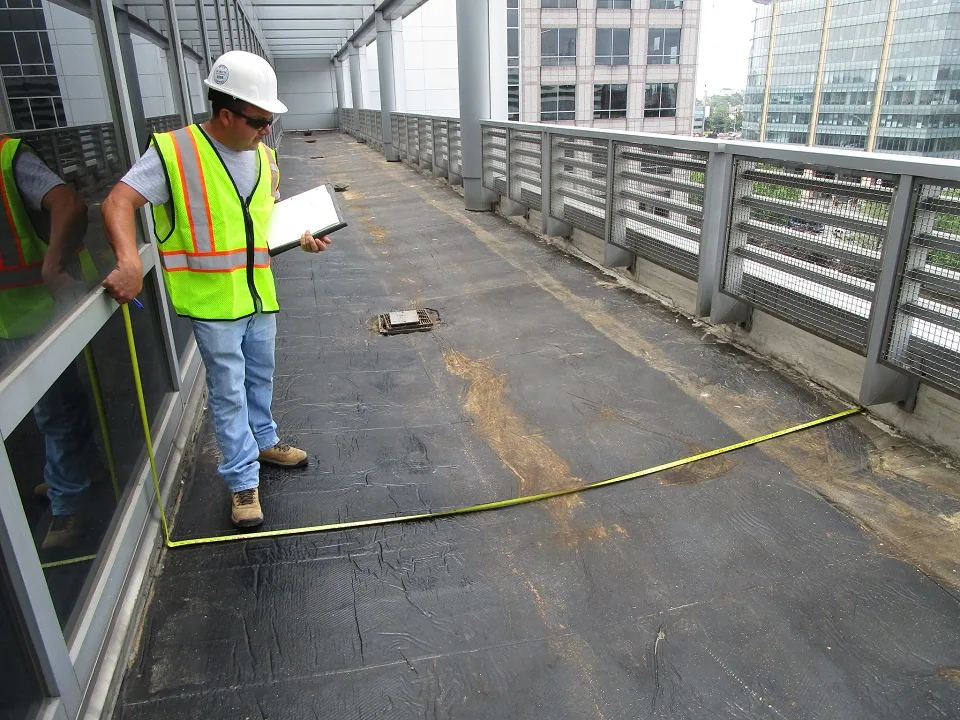
Then the roof itself: drains and ponding rings, seams, laps and flashing at walls and curbs, edge metal and coping. Photographs go on a drawing with location marks. Where an interior stain does not match a visible defect, we trace the deck. A drain and scupper correction is often the cheapest fix on the list, and it protects the rest of the work.
The edge of a small roof is closer to the people below it. A loose coping cap or bent drip edge is a falling hazard as well as a leak path, so the perimeter gets attention early. We press on every cap, check fasteners and sealant, and secure anything that moves. Where metal must be replaced, the new piece matches the profile and is fastened to the spacing that wind exposure calls for.
On a compact roof, sections are small and the days are short. Day one covers the walk, the notice and the staging setup. On day two the first section opens and is sealed before dark. The next day repeats that cycle until the roof is complete. Because the footprint is small, a single bad forecast can move the whole job, so the plan keeps a spare day.
A full commercial roof replacement on a small building can sometimes be done in one pass, with the roof stripped, insulated and sealed in a few days. A repair visit is shorter still. Both use the same notice and the same handoff note, so the manager reads one format whatever the scale.
Handoff notes are brief. Each evening the foreman reports to the manager on what was sealed, how the weather behaved and what comes next. If something unexpected shows up, such as damp insulation under a patch, the note includes a photograph and a price to deal with it. The manager approves the change before more material goes down, so the scope never grows silently.
Lee's Summit sits next door and gets about 38 inches of precipitation a year; its April 27, 2024 warning from the National Weather Service expected roofs to suffer from gusts near 60 mph and penny-size hail.
On lakeside work the hold rule is short: with a storm line in the forecast, the foreman stops, seals the open edge and ties material down. After the storm, perimeter metal, coping and curbs are walked first. A hail damage check looks for bruised membrane and dented metal before the next rain turns a mark into a leak.
Heat and cold set working limits too. Lee's Summit has a July mean high near 88F and a January mean high near 39F, with records of 108F and minus 25F. Adhesives and sealants have working temperatures, so cold-morning repairs wait until the roof warms, and hot-afternoon membrane work is moved to earlier hours.
Debris control matters most when there is no room to spare. Cut membrane, old flashing and insulation scrap go into the bin as each section opens. Loose material never sits on the edge of a roof, where wind can lift it into a neighbor's yard or the water. A magnet sweep of the lot and the drive clears fasteners at the end of the shift.
The dry-in point is set before cutting begins. A shifting forecast shrinks the open area. Temporary seals are tested and noted in the log. Rooftop units are scheduled with the manager so no suite loses heat or cooling for longer than the notice says, and the drains are covered while work goes on and tested at the end.
The manager receives a turnover package with the opened and closed areas, photographs of each layer and a punch list. It tells the next walk what to check first, usually the drains after a heavy rain. The roof condition report describes the roof in the condition it was handed back.
An owner who also has a building in Blue Springs or Lone Jack can hold every roof to one format. Over time those packages show which building needs the next dollar, and the manager can plan capital work from evidence.
The package also records which neighbors were notified and when. If a question arises later about noise or access, the manager has the record in hand and can answer without calling the crew.
Debris goes by chute into a smaller bin that is emptied each afternoon. The plan names the bin location and the pickup time.
The manager receives a copy of the notice for any adjoining property whose access is touched. It names the dates, the closed entrance and the loud hours.
Water has less room to go. A blocked scupper or a loose downspout can send water toward a wall or a neighbor, so discharge points are checked first.
Often within a few days, if the weather cooperates. The plan keeps a spare day for a storm hold.
The address, occupant hours, a roof drawing if one exists and any open leak reports. With those, the walk ends in a written plan.
Send the building address list, tenant hours and any open leak reports. We will walk the roof with the property manager and offer a written sequence plan before any scope is priced.
Request a Roof Assessment