An emergency call at 2 a.m. is a sequence problem, and the sequence begins with a few questions: where is the water entering, is anyone in the building, is the electrical service at risk, and can a crew reach the roof safely. Commercial roofing in Lee's Summit, MO runs around the clock, every day of the week and on holidays, because a storm does not wait for a weekday and neither does a flooded stock room. That holds across Lee's Summit, from the commercial properties along I-470 and MO 291 to the older downtown blocks, and in neighboring Raymore, Belton and Blue Springs.
The objective of an emergency visit is narrow, and it is written down before the truck leaves so every crew member knows the order of work. We stop the water, make the building safe to occupy, document what happened, and leave a dry-in that will survive until the permanent repair can be scheduled. The longer repair is planned after the immediate danger passes, with the manager's input on timing, tenant disruption and budget, and a clear boundary between what was done tonight and what remains.
The dispatcher asks for the address, the roof access point, the type of roof and the nature of the damage. A photograph of the interior or the roof, sent from a phone, saves time because it tells us which materials to load. We ask whether power or sprinklers are affected, and we ask for the name and number of someone who can open the building and the roof hatch.
We also ask whether the manager has a roof drawing and whether any warranty or insurance carrier needs notice. If so, the first photographs are taken with that in mind, because the first photographs become the record of the condition before any temporary work covers it.
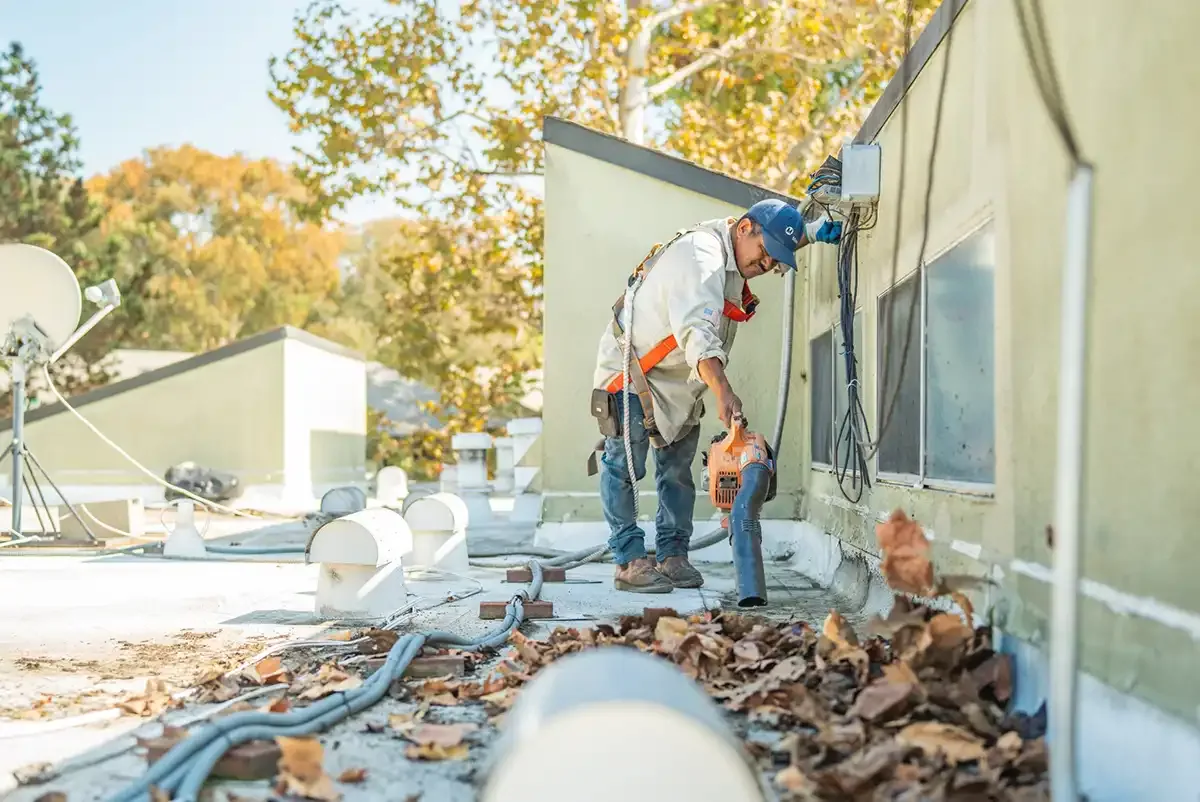
Crews arrive with tarps, sheet goods, sealant, patch material, fasteners, lighting, and fall protection. Wind, ice and wet surfaces change the safe approach, and we do not send anyone onto a roof that cannot be reached safely. When lightning or high gusts are active, the roof waits and interior protection comes first.
The access route is chosen to avoid tenants and customers. At a shared building along I-470 or US 50 in Lee's Summit, that may mean a rear stair, a service corridor or a ladder at the dock, and the manager helps arrange the door codes or keys ahead of the crew.
The first target is the opening. Debris is cleared, loose membrane is cut back to sound material, and the damaged area is covered with a patch, a sealant-and-fabric repair or a mechanically secured tarp. On a membrane roof the cover is lapped over the high side so water sheds across it, and edges are fastened so wind cannot lift the cover.
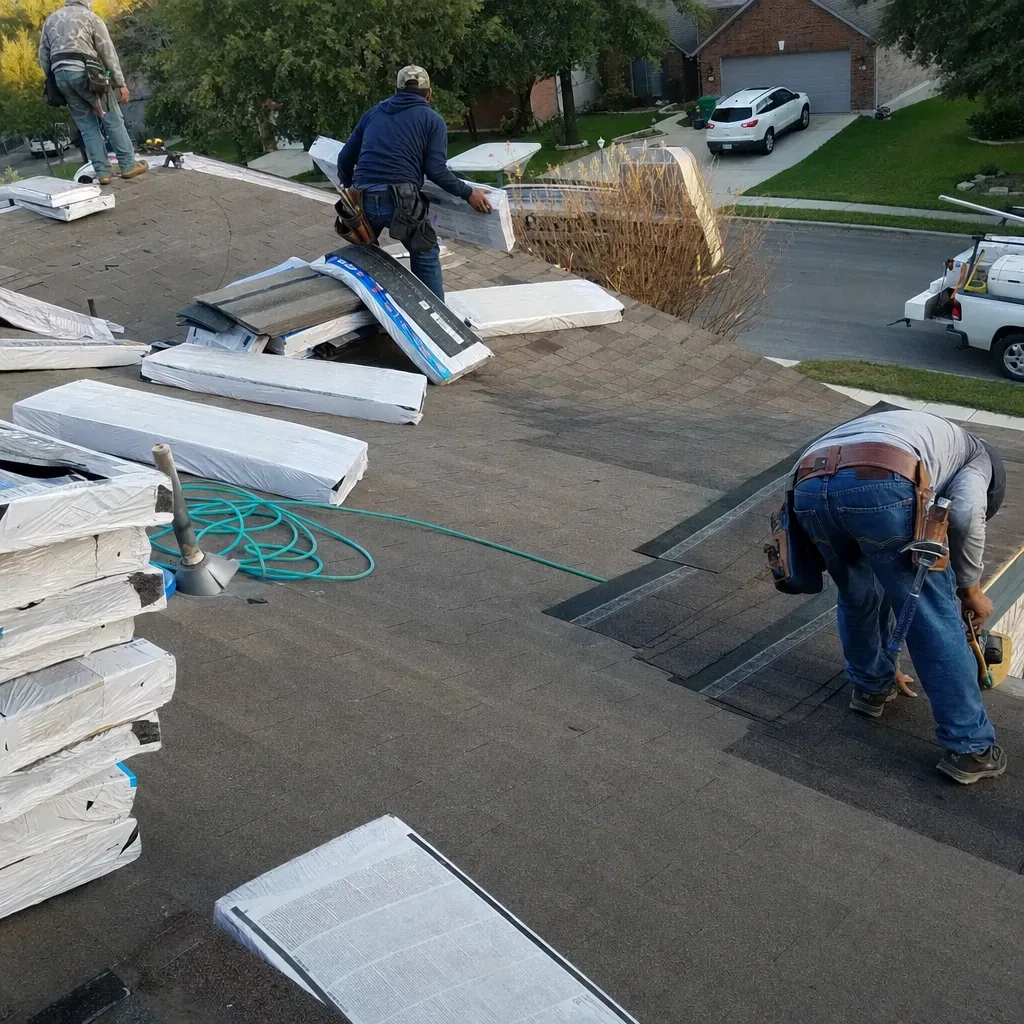
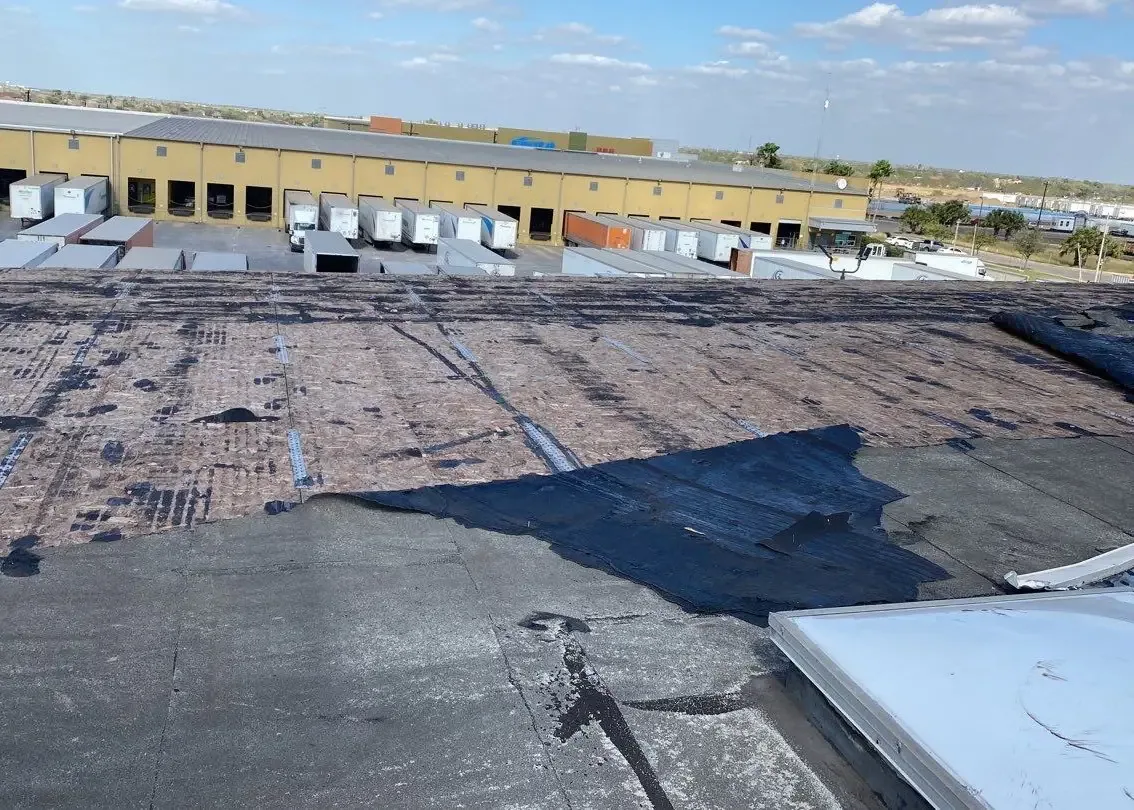
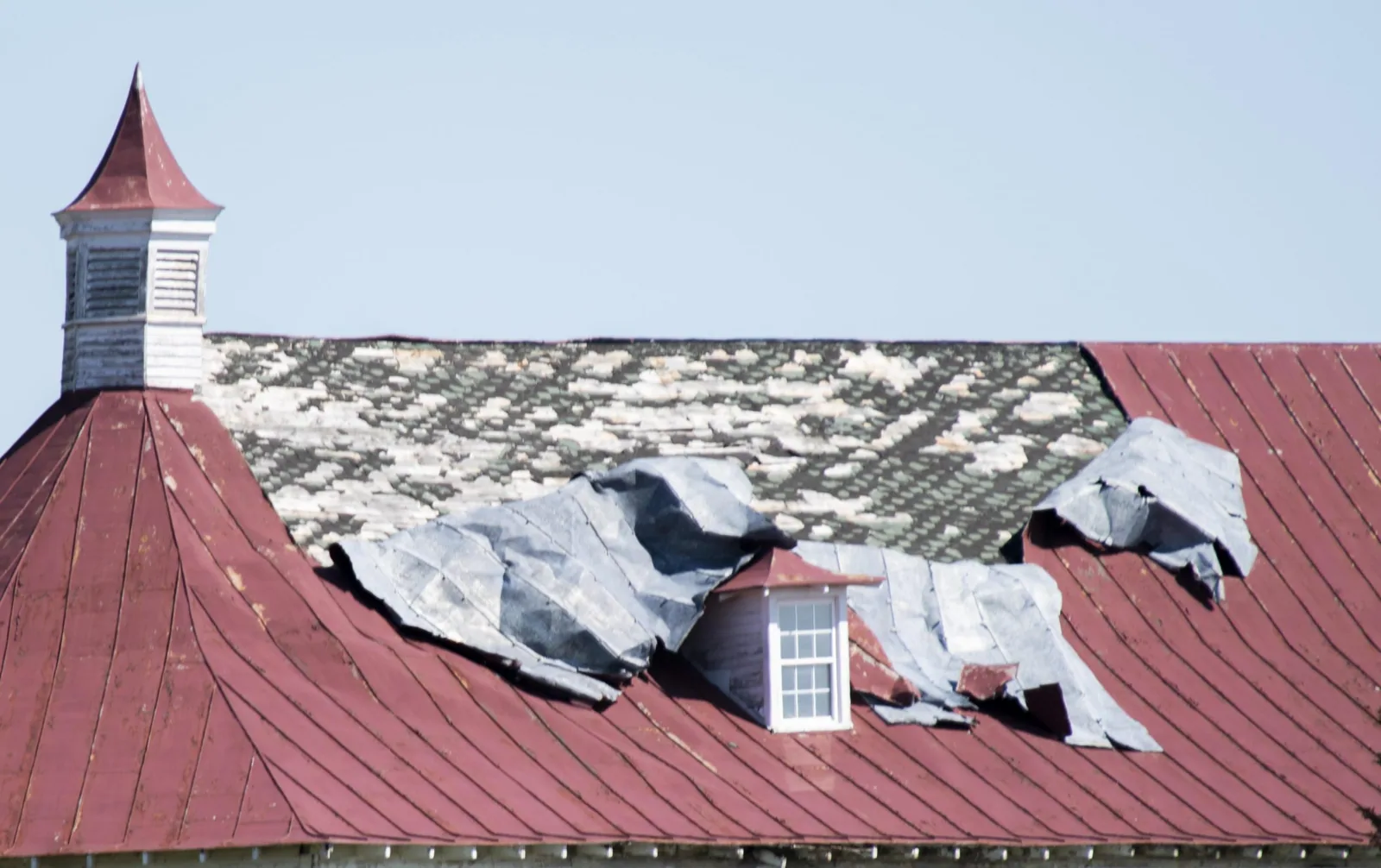
If storm winds have lifted or torn a section of roof, the work becomes more extensive. Open decks are covered with sheathing and a temporary membrane, and loose metal is removed or secured so it does not become flying debris. The aim is a stable dry-in that lasts through the next storm.
Inside, we work with the manager on ceiling tile removal, plastic sheeting over stock and equipment, and containment of wet insulation. Standing water on the floor and wet electrical equipment are flagged, and a restoration contractor is called when drying and moisture mapping are needed. Where tenants are affected, the manager receives a brief note on what was done and what to expect next. Electrical and fire protection systems are left to electricians and fire protection contractors, and we mark the roof and ceiling areas they will need to reach.
Photographs of the interior are taken before cleanup begins. They show the extent of the water intrusion, the affected finishes and the location of the roof opening, and they support any insurance claim that follows. Wet insulation is cut and bagged where it can be reached, since it holds water against the deck long after the surface looks dry, and the location of each cut is marked for the permanent repair.
Severe weather in the Kansas City area arrives as spring and summer thunderstorm lines, hail and sometimes tornadoes. The National Weather Service office at Pleasant Hill warned of roof damage on April 27, 2024 in a line of storms that named Lee's Summit. An EF3 tornado in Oak Grove on March 6, 2017 damaged 483 houses and 12 businesses, and a tornado damaged roofs in Unity Village on July 1, 2015.
Winter has its own emergencies. Lee's Summit's January mean daily high is 39.0F, and freezing drains, ice at scuppers and the weight of snow can produce a sudden failure. The permanent work after a tornado or a high-wind event, such as tornado damage repair or wind damage repair, follows the emergency dry-in once the deck and edges have been inspected.
Once the building is dry, we return with a written report: what failed, what temporary measures were used, how long they should hold and what permanent work is recommended. The report includes photographs and a drawing showing the damaged area, and it is formatted for an insurer or an owner's representative.
The permanent work depends on the damage. A torn seam is a planned repair, a wide wind failure may require a storm damage scope, and an old roof with wet insulation may be due for replacement. We help the manager sort those paths while the damage is fresh, and we keep the dry-in in place until the permanent crew starts.
Clear a path to the roof access, shut off power to affected circuits if it is safe to do so, move stock and equipment out of the water, and send photographs. Keep people away from damaged ceilings. If the roof is open to the sky, stay off it, because wet decks and loose metal are dangerous.
Response time depends on the hour, the weather and how many buildings are affected, so we give an estimated arrival on the first call and update it as the situation changes. In a widespread storm, buildings with active water entry and safety risks are served first, and others follow.
After-hours and storm response carries a premium for labor and materials, and the proposal says so before work starts. The temporary dry-in is priced as its own item so the permanent repair can be quoted separately once the building is safe, and the two scopes do not get mixed.
Prompt temporary protection is generally expected, and the photographs and report we provide record the damage before it is covered. The carrier makes the coverage decision, but a clear record of the cause, the dry-in and the permanent scope makes the conversation more straightforward.
A tarp is a short-term cover and is not meant to carry a roof through months of freeze, snow and wind. Where the permanent repair cannot be scheduled promptly, we upgrade the cover to a fastened temporary membrane and inspect it after each storm. The permanent work follows when weather allows.
Give us the address, the access contact and what you can see. We will confirm an arrival time on the first call and start the dry-in as soon as the roof is safe to reach.
Request a Roof Assessment