
A hotel roof is worked between checkout and check-in. Housekeeping turnover, breakfast service, the pool schedule and the arrival of a tour bus all decide when the lot, the porte-cochere and the service door are free for a crew. The first site walk with the general manager and chief engineer settles truck routes, material storage and the nightly sealing point, and marks the guest rooms and meeting spaces that sit under each roof area. In Lee's Summit, MO, commercial property runs along I-470, US 50 and MO 291, and nearby Blue Springs is served by I-70 and Missouri Route 7, so a hospitality owner may hold properties on several of those routes. The roof's condition then points to a repair or a phased commercial roof replacement.
Guests notice noise before they notice anything else. A hammer overhead at eight in the morning is a one-star review, so we plan around occupancy. The top floor is the most exposed to roof noise, and the hotel can choose to hold those rooms out of inventory during the loudest steps. We ask for the occupancy forecast, the rooms most likely to be sold and the blocks that cannot move.
Loud steps such as tear-off and fastening are placed in the mid-day window, after checkout and before arrivals. Quiet work, such as flashing and cleanup, fills the edges of the day. A notice for the front desk explains the schedule and what to say if a guest asks. Rooms directly under open sections are protected and checked each evening.
Meeting rooms and ballrooms are a special case. A leak over a ballroom can cancel an event and cost far more than the roof repair, so events are placed on the calendar first, and the roof above the ballroom is worked in the weeks when no event is booked. If a booking cannot move, that section waits.
Housekeeping and engineering staff are partners in the schedule. The chief engineer knows which rooms have had leaks, which ceilings have been patched and which areas are sensitive, and that knowledge goes onto the roof drawing before the walk ends.
A hotel roof combines several moisture sources. Indoor pools, laundry, kitchens and guest bathrooms all push warm, humid air upward. In cold weather, that air can condense in a roof assembly that lacks a proper vapor path, and the damp insulation then looks like a leak from inside.
On the first walk we check the ceiling edge for staining, fasteners for rust and the insulation near exhaust points for softness. An infrared moisture survey separates true leaks from condensation, since one is repaired at the membrane and the other in the assembly or the ventilation. Lee's Summit has a humid continental climate with a January mean high of 39F and a July mean high of 88.3F, so a hotel roof deals with both ends of the year.
Exhaust from guest bathrooms and laundry rooms discharges through many small penetrations. Each boot or hood is checked for cracks, corrosion and loose fasteners, and the cheap ones are replaced during the visit. A rotted boot over a guest room is a small part that causes a large problem.
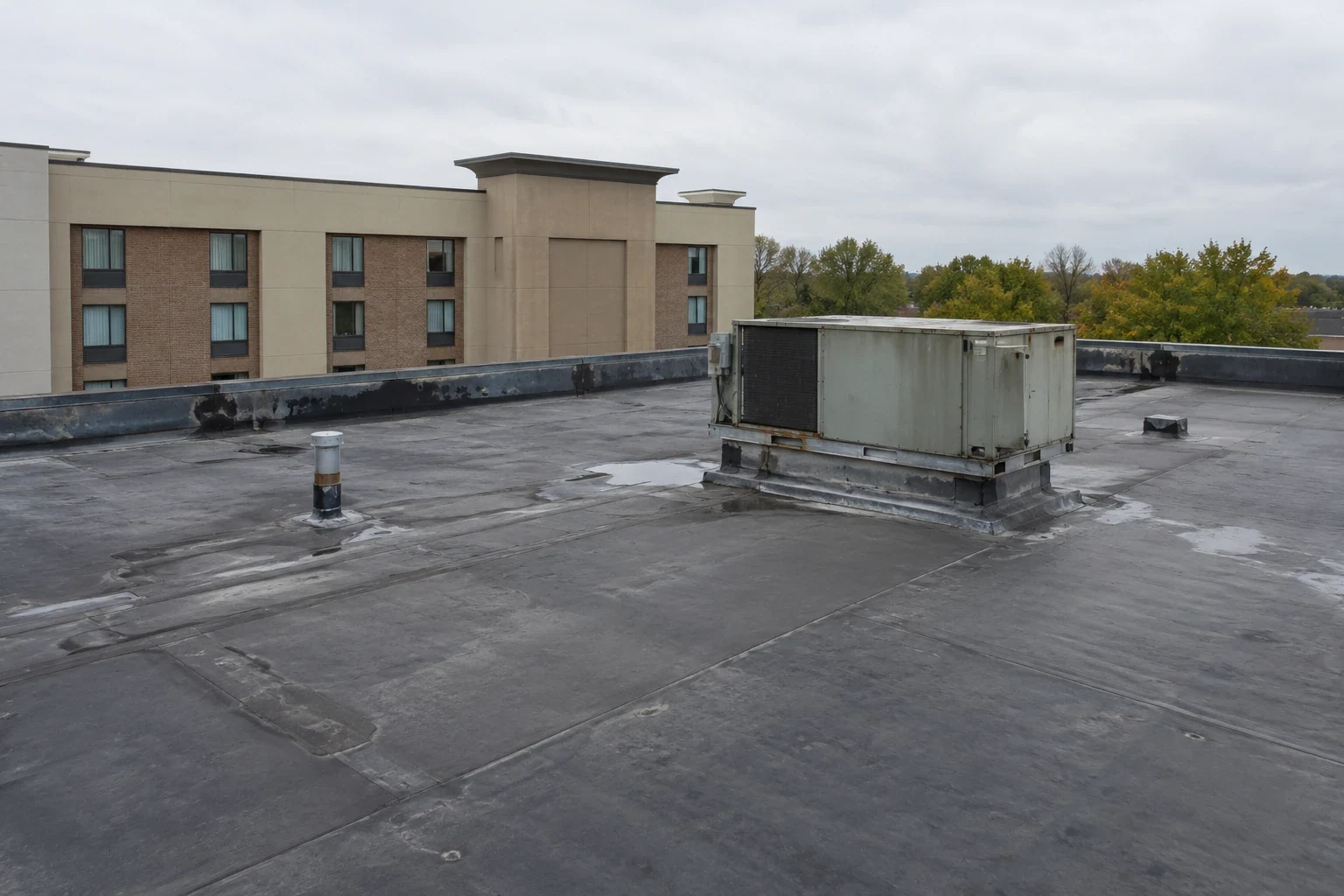
Hotel roofs carry rooftop units, exhaust fans for bathrooms and kitchens, make-up air and sometimes decorative features. Each is on a curb, each has flashing and each has a service path. We inventory them on the walk and check every curb, boot and seal.
Exterior corridors, balconies and canopies have their own roofs and drainage. A clogged downspout on a balcony roof can overflow onto a guest walkway, and a canopy over an entrance drips on arriving guests if its edge is damaged. These smaller roofs get the same attention as the main one, and the schedule keeps entrances open during the work.
Lift machine rooms, stair towers and parapet walls rise above the main roof and make the junctions complicated. Counterflashing at those walls, sealant at their copings and the drainage around their bases need a close look, since water running down a tall wall concentrates at the roof edge.
Many hotels operate under franchise or brand standards, and a renovation cycle can force a roof decision. If guest rooms are being refreshed, the roof should be sound first, since new finishes under a leaking ceiling are a waste. We line up the roof work with the renovation calendar and ask for any brand requirement that touches the roof, such as colors, signage attachments or mechanical screening.
For a group with several properties, a multi-site roof program ranks each hotel by condition, groups work by market and fits the roof into each property's renovation window. The same file format serves every site, and regional managers can compare them in one view. A hospitality owner with restaurants or event space attached can use the same approach used for retail and restaurant chains.
Owners who are also investors will recognize the documentation: a real estate investor underwriting a hotel purchase asks for the roof condition report, the remaining life estimate and the repair history, and the same file answers those questions.
Spring storms reach a hotel's revenue as well as its roof. The April 27, 2024 warning for Lee's Summit spoke of 60 mph gusts and penny-size hail, and it expected roof damage. A leak into a guest room takes the room out of service, and several can take out a floor.
Our emergency roof repair crews answer calls at night and on holidays. The first step is a temporary seal that stops the water, then a moisture map and photographs for the insurer, then a permanent repair planned for the hotel's slowest days. A turnover package follows every job, with dated photographs, the closed punch list and warranty documents.
Guest safety comes into the storm plan. Loose roof material, falling debris and open penetrations can hurt people on walkways and in parking areas, so a post-storm walk checks ground-level hazards too, and the crew secures the area before leaving.
Usually, with the work phased by wing and the rooms under active sections held out of inventory. The general manager chooses which rooms to block and for how long.
Loud steps are placed in the mid-day window, fastening methods are chosen with noise in mind and top-floor rooms under the work can be blocked. A notice to the front desk explains the schedule.
Condensation from humid air or a leaking supply line is common. Surveying the roof for moisture and checking the ventilation shows whether the cause is the roof or something else.
Late spring through early fall for dry weather, but spring storms need strict weather holds. The hotel's slow season, if it has one, can also set the window.
We record the damage with photographs, a roof drawing and moisture readings, and provide a written summary. The owner sends it to the insurer.
The room layout, any record of past leaks by room number, the rooftop equipment list and the roof access method. Occupancy forecasts for the work period help us place the loudest steps.
Send the property address, room layout, occupancy calendar and any open leak reports. We will walk the roof with the general manager and engineer and write a wing-by-wing sequence plan before any scope is priced.
Request a Roof Assessment