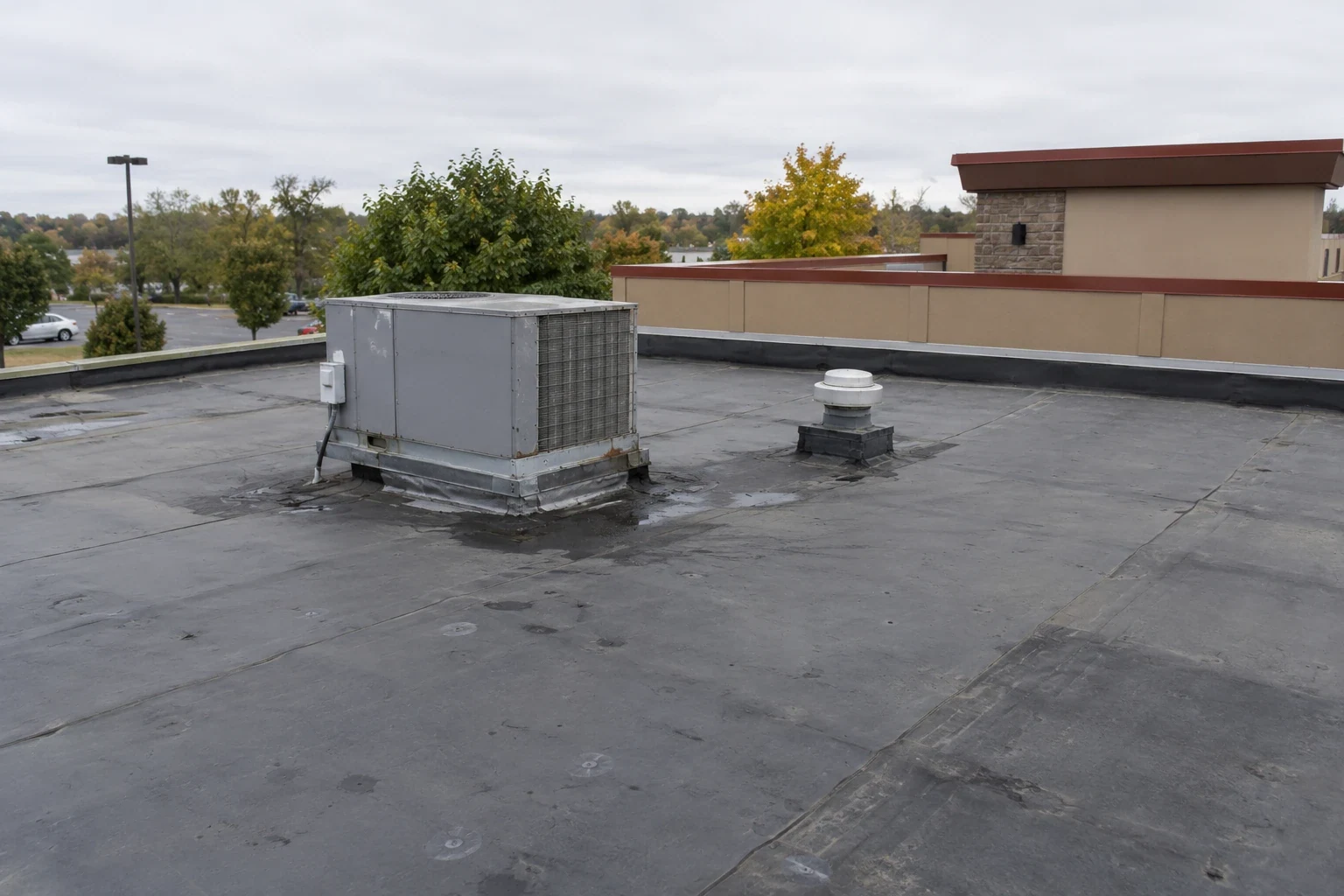
A store roof is worked between the lunch rush and the evening rush, or before the doors open. Hours, deliveries, drive-through lanes and customer parking decide where the lift may stand and which door the crew uses. The first step with a multi-location brand is a walk at one site, to settle truck routes, material storage and the nightly sealing point, and then a repeatable plan for the rest. In Lee's Summit, MO, retail centers such as Summit Woods Crossing and Summit Fair sit among commercial areas along I-470, US 50 and MO 291. The roof's condition then points each store to a commercial roof repair, a recover or a replacement.
Retail roofs, from a shopping center to a big-box store, sit above people who are buying things, so the plan starts with when they arrive. We ask each store for its hours, its busiest periods, delivery windows and any events. Loud work moves to the slowest hours, and the crew entrance is placed away from the customer door.
Restaurants add a second layer: kitchen prep before opening, a lunch peak, a dinner peak and late-night cleaning. The roof above the kitchen is worked when the kitchen is least busy, and the dining room ceiling is protected before the first panel is lifted. A notice goes to the manager with dates, hours and a phone number for the site lead.
Deliveries and drive-through lanes need their own thinking. A lift cannot sit in a drive-through, and a delivery truck cannot be blocked from its dock. We mark both on the site plan and agree on staging with the manager. A spotter watches pedestrian crossings and the crew keeps hoses, cords and tools off customer walkways.
Training the store team helps. A manager who knows which ceiling tiles to watch, where the roof hatch is and whom to call can report a leak in minutes, and the first hour of response can be the difference between a stain and a closed aisle.
A restaurant roof has a particular problem: grease. Exhaust fans discharge grease-laden air that settles on the membrane, and some membranes break down under it. A stained patch beside a fan is the first warning. Drip trays, grease containment and a membrane suited to the exposure all help.
We inventory every exhaust fan, make-up air unit and rooftop unit on the first walk, check the curb and flashing at each and log the discharge conditions. When a unit is replaced, the curb is renewed during the swap and the discharge is aimed away from the sheet. Cleaning schedules for the fans, which the operator or its vendor controls, make a large difference to roof life.
Skylights and decorative roof features, such as parapet signs and mansard returns, add detail work. A sign attached through the parapet can be a source of leaks, and a mansard return can hold water behind its fascia. Each is checked on the walk and resealed or reflashed, with the sign vendor called if a panel must come off.
A chain store may lease space in a center where the landlord owns the roof, and the lease sets who repairs what. Even so, a leak in the store is the tenant's problem on the day, and the tenant's equipment may be the cause. Photographs of the roof opening, the equipment and the repair settle disputes quickly.
We work with whichever party holds the responsibility and keep the other informed. For a landlord-owned roof, the report goes to the property manager and the tenant's facilities contact together. Retail settings around the metro raise the same question: Town Center Plaza in Leawood, shopping along North Oak Trafficway in Gladstone, and the restaurants and businesses of Martin City are retail settings where a store, its landlord and its neighbors all want the same roof record.
Grocers and big-box tenants are the larger cases, with long roofs, heavy refrigeration equipment and many penetrations. Their facilities teams may want a written scope and photographs of any roof opening in advance, and we supply both. Where a grocery store roof is the question, refrigeration condensers get a separate drainage and curb check.
A brand with locations across the metro needs one standard and a schedule that runs in waves. We rate every roof on the same scale, rank the stores by condition and group work by market so travel and mobilization are efficient. A multi-site roof program sets the order and the budget for each wave.
Brand rules matter too. Some chains specify roof colors, parapet details or sign attachment methods, and we ask for them at the start. Where a standard exists, the turnover package states how each site met it. Every store gets the same report format, which keeps regional facilities managers working from one view.
Funding cycles matter in a chain. A brand that budgets roof spend by region wants to know which stores will need money next year and which can wait. Hotel and restaurant groups in hospitality use the same approach. The ranking gives each regional manager a short list with reasons, and the next year's list updates from the latest visit.
Retail stores lose sales when water enters. Lee's Summit was warned on April 27, 2024 about gusts near 60 mph, penny-size hail and roof damage. A store with a leaking ceiling may need to close an aisle, a dining area or a register lane, so response speed counts.
Our emergency crews work day or night, including holidays, and the first goal is a temporary seal that keeps the store open. A dated photograph set and a moisture map follow, so the brand can handle an insurance claim or a landlord notice with evidence in hand. The permanent repair is scheduled in the store's slowest hours.
Hail leaves marks that fade. A dated walk soon after a storm records bruised membrane, dented units and displaced trim while they are clear, and the record helps separate storm damage from wear when a claim is discussed with the landlord or an adjuster.
Often, if the work is zoned and the dining room ceiling is protected. The roof above the kitchen is worked in the slowest hours, and the manager approves each day's area.
We coordinate with both the landlord's property manager and the store's contact. The lease sets who approves and pays, and the report goes to both.
Regular fan cleaning, drip trays or grease containment and, in severe cases, a membrane that resists grease. The first walk shows which applies.
A single trip can cover stores in the same area, with a separate report for each. The report format is identical, so the stores can be compared.
Colors, parapet and sign details, and sometimes the system itself. Where a standard exists, we record how each site meets it.
The roof goes first, or in the same phase, so new interior finishes are never exposed to a leak. The remodel schedule and the dry-in date are lined up in one calendar.
Share the store addresses, hours, landlord contacts and any open leak reports. We will walk a first site, then write a repeatable sequence plan for the rest before any scope is priced.
Request a Roof Assessment