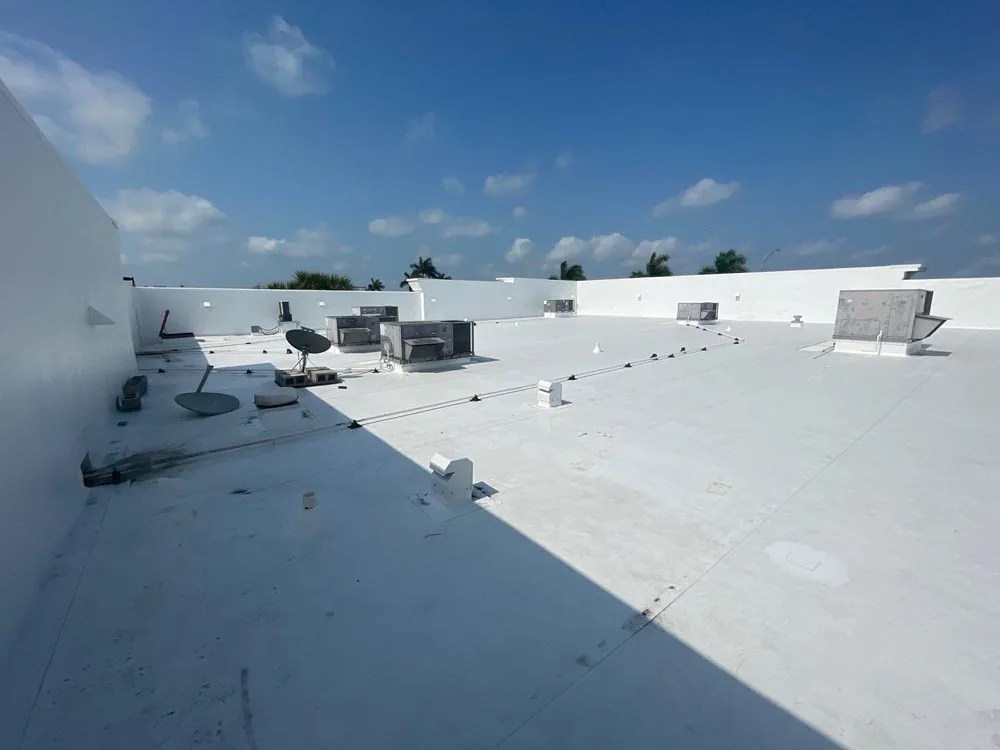

Before a modified bitumen roof is ordered, someone has to decide how the plies will be fastened to the building, and that choice carries a safety plan with it. Torch-applied rolls need a fire watch and a clear zone around the work. Self-adhered and cold-applied rolls need warm, dry surfaces and patience. In Lee's Summit, MO, where a commercial roof may sit over working suites or beside an older downtown block, we choose the method with the fire marshal, the building engineer and the tenant notice in view, then settle the membrane.
Modified bitumen is asphalt blended with a polymer that gives it elasticity. The roll is a factory-made sheet with a reinforcing mat in the middle and a surface layer of granules, foil or smooth finish on top. Two polymers dominate. SBS, a rubber-like additive, gives the sheet flexibility and recovery in cold weather. APP, a plastic-like additive, gives it stability in heat and resistance to ultraviolet light.
Both are installed in multiple plies, usually a base sheet and a cap sheet, so the roof has redundancy that single-ply sheets lack. A puncture through the cap still meets a second layer. That layered build is why modified bitumen has remained in use on commercial roofs for so long, and why we still specify it where traffic, impact or debris are concerns. It is also the descendant of built-up roofing, with the same idea of stacked layers delivered as factory rolls instead of mopped felts. The factory sheet has a consistent thickness, which removes much of the variability a mopped roof carries. Cost follows the number of plies, the surfacing, the attachment method and the amount of flashing to be built by hand around curbs and walls.
Four methods apply the plies. Torch application melts the underside of the roll with a propane flame and presses it down. Hot asphalt mopping uses a kettle. Cold adhesive uses a brushed or sprayed compound. Self-adhered sheets have a sticky underside that bonds when pressure is applied.
Open flame is the method that most affects an occupied building, which is why the choice is made with the building engineer in the room. Torch-free methods are the sensible choice near older structures such as the Italianate and Moderne commercial buildings of the Lee's Summit Downtown Historic District, which date from 1850 to 1974. We keep fire watches, extinguishers and a check of the area after the last flame, but our first preference on occupied or older buildings is a method that leaves flame out of the plan.
The layered build resists punctures. On April 27, 2024, the National Weather Service warned of penny-size hail and 60 mph gusts across Lee's Summit, and a granule-surfaced cap sheet absorbs impact better than a thin single-ply sheet. Bruises still occur, and they hide under granules. After any storm we walk the roof, press on suspect areas and look for lost granules and cracked plies, then document findings for a hail damage repair claim if the roof needs it.
Tornado debris is a different test. An EF3 tornado hit Oak Grove on March 6, 2017, damaging 483 houses and 12 businesses, which is a reminder of what wind-borne debris does to a roof. A multi-ply roof is not tornado-proof, but a puncture through the cap sheet meets a second ply, and the repair is quicker than a single-layer failure. Wind resistance depends on how the base sheet is attached, so fastener patterns are set for the corners and edges.
A modified bitumen roof is exposed to a record low of -25F and a record high of 108F in Lee's Summit, and to the expansion and contraction between them. SBS products suit this range because they keep their stretch in the cold. Ice from a storm like the 2002 event that left hundreds of thousands of Kansas City residents without power loads edges and drains, and the plies around drains and scuppers take the abuse.
Cold also limits installation. Rolls become stiff, adhesives slow and surfaces collect frost. We store rolls warm, install in the daytime and hold the work when temperatures fall, so a cold snap interrupts the schedule but not the seams. Drains get special attention before winter: strainers are cleared, sumps are checked for slope, and any ponding at a drain is corrected, since ice at a clogged drain lifts the plies around it. Repairs for snow and ice damage are staged for the first dry day.
The laps between rolls carry the roof's watertightness. Each side lap and end lap needs a continuous bleed-out of asphalt at the edge, which proves the layers fused. A lap without it is marked and reworked. Flashings are built as separate multi-ply assemblies at walls, curbs and penetrations, and the cap flashing seals the top.
The surface layer matters as much as the plies beneath it. A roof that is walked often, such as one with frequent service to rooftop units, wants walk pads laid over the granules, because foot traffic scrubs them off. Granules shield the asphalt from sun, and a bare patch ages faster. Reflective coatings can be applied over a cap sheet, which is an option when TPO or white membranes are being compared. For equipment curbs in particular, we build the flashing before the cap sheet is laid.
Modified bitumen roofing is installed in bands that can be closed by evening. A band includes the base sheet, the cap sheet and the flashings, and each is walked before the crew leaves. Dock and entry hours control hoist and staging locations, and tenant notice lists the hours of noise and the odor expected from adhesives or asphalt. A roof along Lee's Summit commercial corridors such as MO 291 and US 50 may need an air-intake plan if cold adhesive is used. Spring is the storm window, so weather hold rules are written down before the first roll is opened. The result is a roof replacement or recover that can be inspected ply by ply.
No. Self-adhered and cold-applied systems avoid open flame entirely. We use them on occupied buildings, older structures and any roof where a fire watch cannot be arranged. Torch application remains a tool for specific conditions.
SBS stays flexible in the cold and suits a climate that reaches -25F. APP stays stable in heat and sun. We usually recommend SBS for cap sheets in this region unless a roof has a specific reason to prefer the other.
Often, if the old roof is dry and flat enough. A moisture survey and core cuts give the answer. A base sheet is mechanically attached or adhered over a cover board, and the cap sheet follows.
Look for bare spots where granules were knocked loose, soft areas that give underfoot and cracks along ply edges. We press and mark each suspect location during a post-storm walk and photograph it against the roof plan.
Asphalt and some adhesives release odor as they are heated or applied. We plan access, ask building engineers to close fresh-air intakes during application and favor low-odor methods near air handlers, clinics and offices.
Send the roof plan, the building's hot work rules and your tenant hours. We will walk the roof with the property manager and return a written sequence for the modified bitumen scope before any price is set.
Request a Roof Assessment