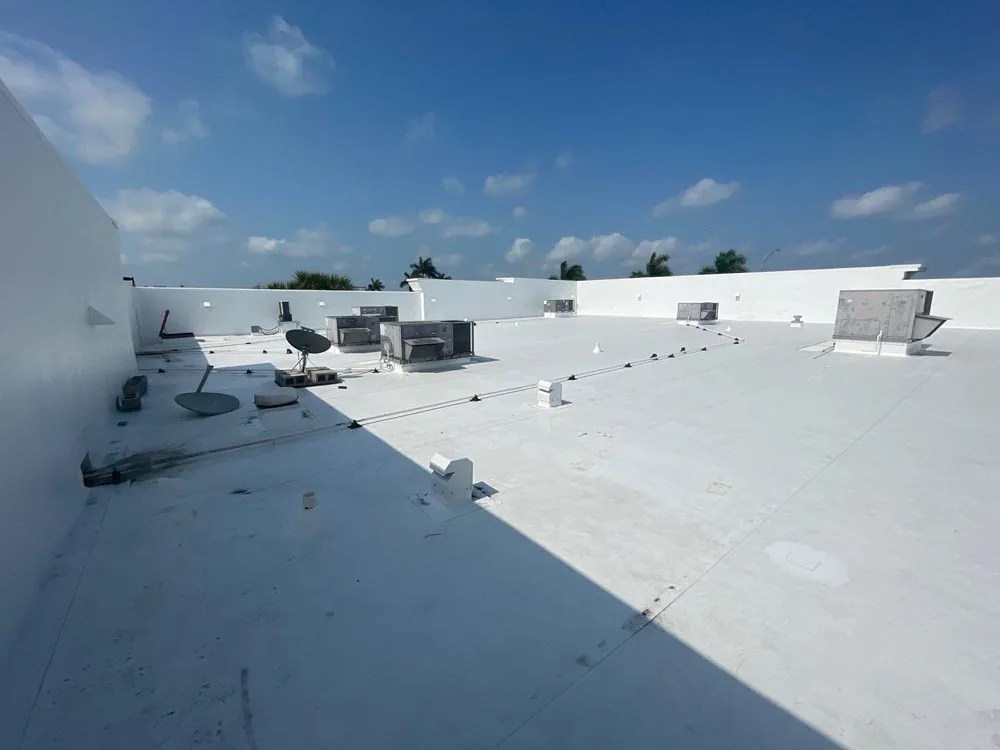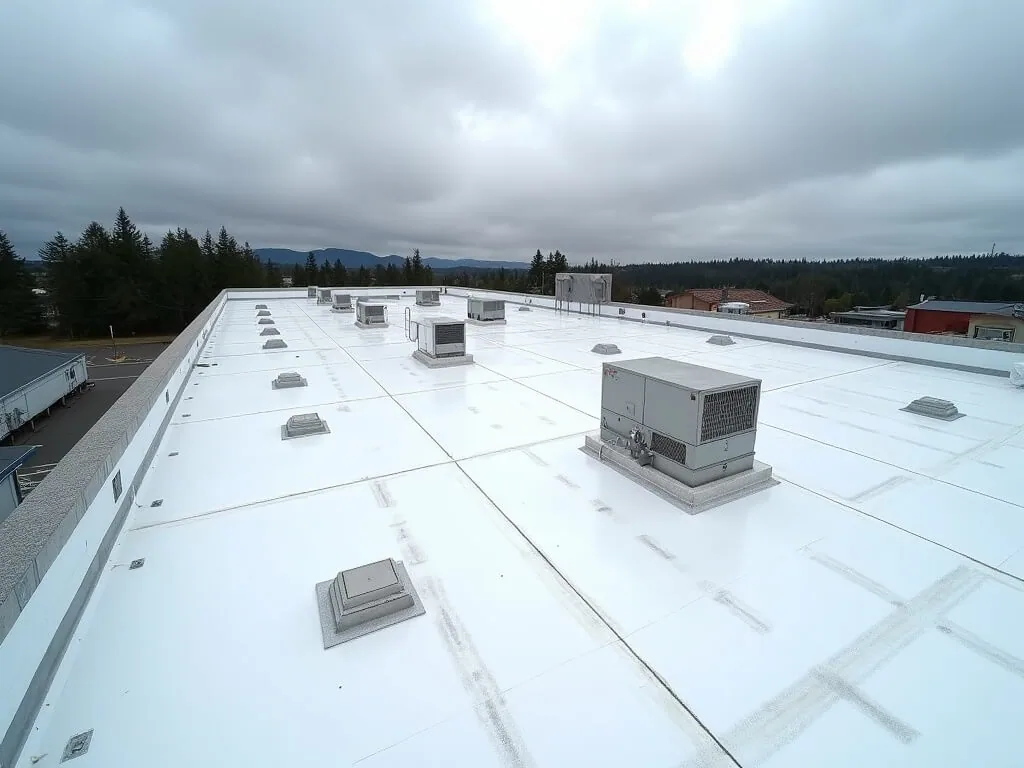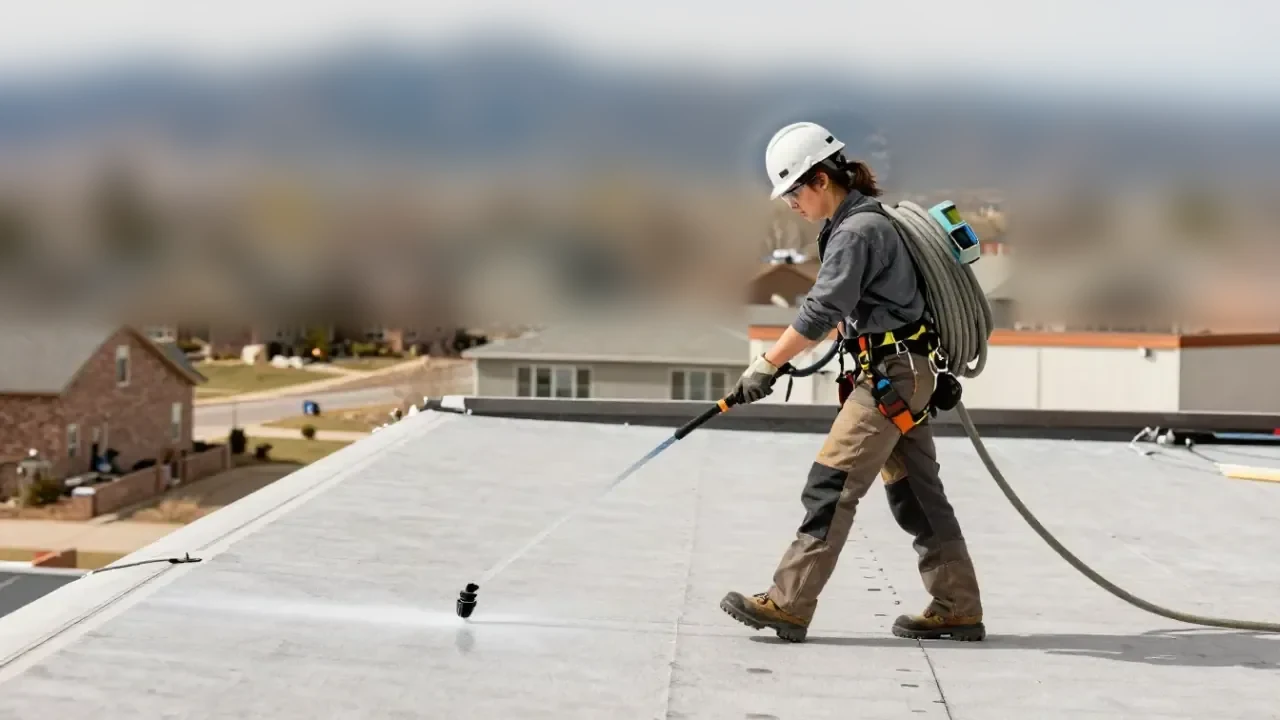

A TPO job begins on the ground, with the notice to tenants and the path a roll truck will take to the staging footprint. The membrane itself is the simple part. It arrives in wide white rolls, is laid over insulation, and is welded at the seams with hot air into one continuous sheet. For retail centers, offices and mixed-use buildings in Lee's Summit, MO, TPO is a common single-ply choice because it can be installed in phases, welded watertight at day's end, and finished without the fumes or open flame that some older systems bring to an occupied building.
TPO stands for thermoplastic polyolefin. The sheet is a blend of polymers with a reinforcing scrim in the middle, and its surface carries additives against ultraviolet light and heat. Because it is thermoplastic, the sheet softens under hot air and fuses to its neighbor, which is what makes a welded seam stronger than a glued one when it is done right. Membrane thickness is sold in a range of gauges, and a heavier gauge gives more margin against foot traffic, hail and wear.
TPO is not one product. Formulations vary between manufacturers, and the same sheet that ages well in one climate can craze in another. That is why we read the actual product data sheet, not just the family name, before recommending a membrane for a building. Where chemical exposure or grease is part of the picture, a PVC membrane may be the better fit, and where a building needs a rubber sheet with a long record in cold, EPDM is on the table. The comparison is made for each roof, not for the family. Cost follows gauge, attachment method, insulation thickness, and the number of curbs and penetrations the crew has to detail by hand.
A TPO roof is held down in one of three ways. Mechanically attached systems use fasteners and plates along the seams and are the quickest to install. Fully adhered systems bond the whole sheet to the insulation, which gives a smooth look and spreads wind uplift evenly. Ballasted systems hold the sheet down with stone and are used less often.
The choice follows the building. A low-rise shopping center with a long, open field of roof often takes a mechanically attached sheet. A roof with many curved edges and parapets may call for fully adhered. Wind exposure counts too: Lee's Summit drew a National Weather Service warning on April 27, 2024 that cited gusts near 60 mph, and a fastener schedule has to be set for the corners and perimeter, where uplift is highest.
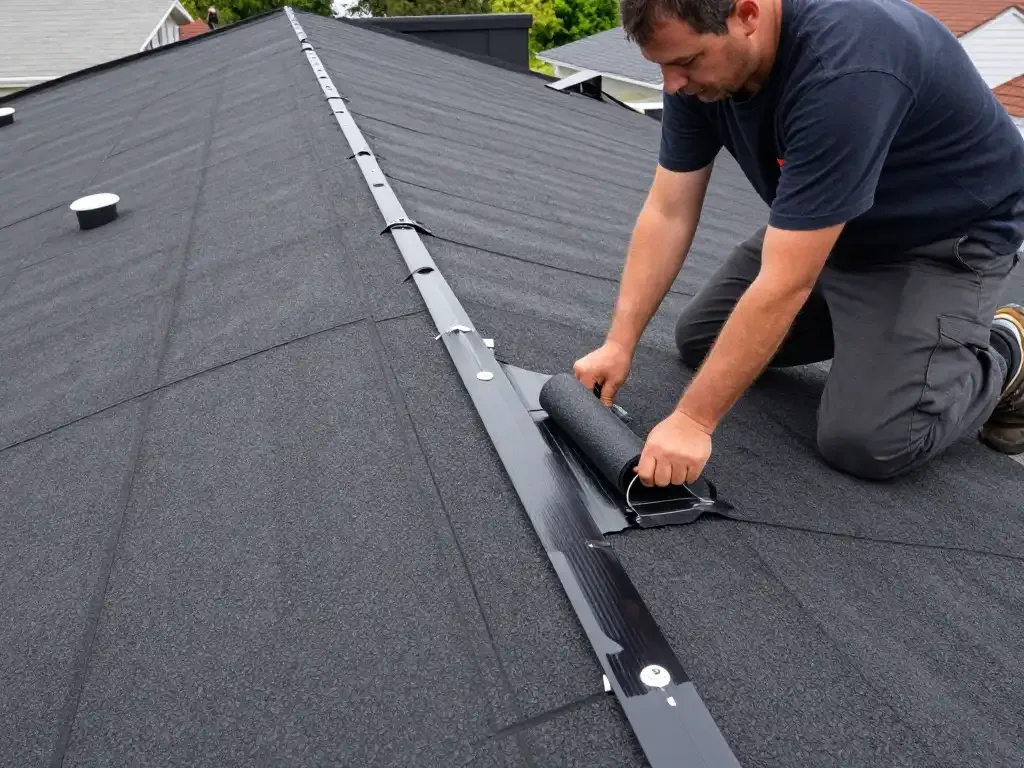
The weld is the whole point of TPO and also its most common failure. A seam that was welded cold, over dust, or in damp conditions can look closed and still be open underneath. Every seam is probed with a pointed tool along its length, and any weak section is welded again. At the end of each phase, the day's seams are walked and marked on the roof drawing.
Test cuts of the welds, taken at set intervals, show whether the heat and speed of the welder are right. A seam failure that reaches the roof after a few years is nearly always a workmanship problem, which is why we treat seam failure repair as a study of the pattern and not just a patch. A pattern along a line points to deck movement or an attachment fault, not a bad day of welding.
A white TPO surface reflects much of the heat that would otherwise load the building, and in a city where July afternoons average 88.3F and the record is 108F that matters to the cooling schedule. The same city has a record low of -25F, so the sheet also has to stay flexible in the cold and resist cracking at the seams where it moves.
Hail is the other test. The April 2024 warning mentioned penny-size hail, and a bruise in a TPO sheet may not leak on the day it forms. We inspect after any storm that reaches the area, press on suspect spots and mark them for follow-up, and the findings feed the hail damage repair record if an insurance claim follows. Thicker membrane and a firm cover board under it both resist impact.
Most leaks on a TPO roof begin at a detail, not in the field of the sheet. Walls, curbs, drains and pipe penetrations all rely on a flashing that was cut, formed and welded by hand. A rooftop unit curb with a flashing that is a few inches too short will leak even when the membrane around it is perfect. We use pre-formed corners and boots where they fit, and field-fabricated flashings where they do not, and every one is probed.
The roof edge needs the same care. Edge metal takes the greatest wind load on the roof, and its attachment and sealant joints are checked against the wind rating for the building. Where a property has several equipment curbs, we look at each one on the first walk.
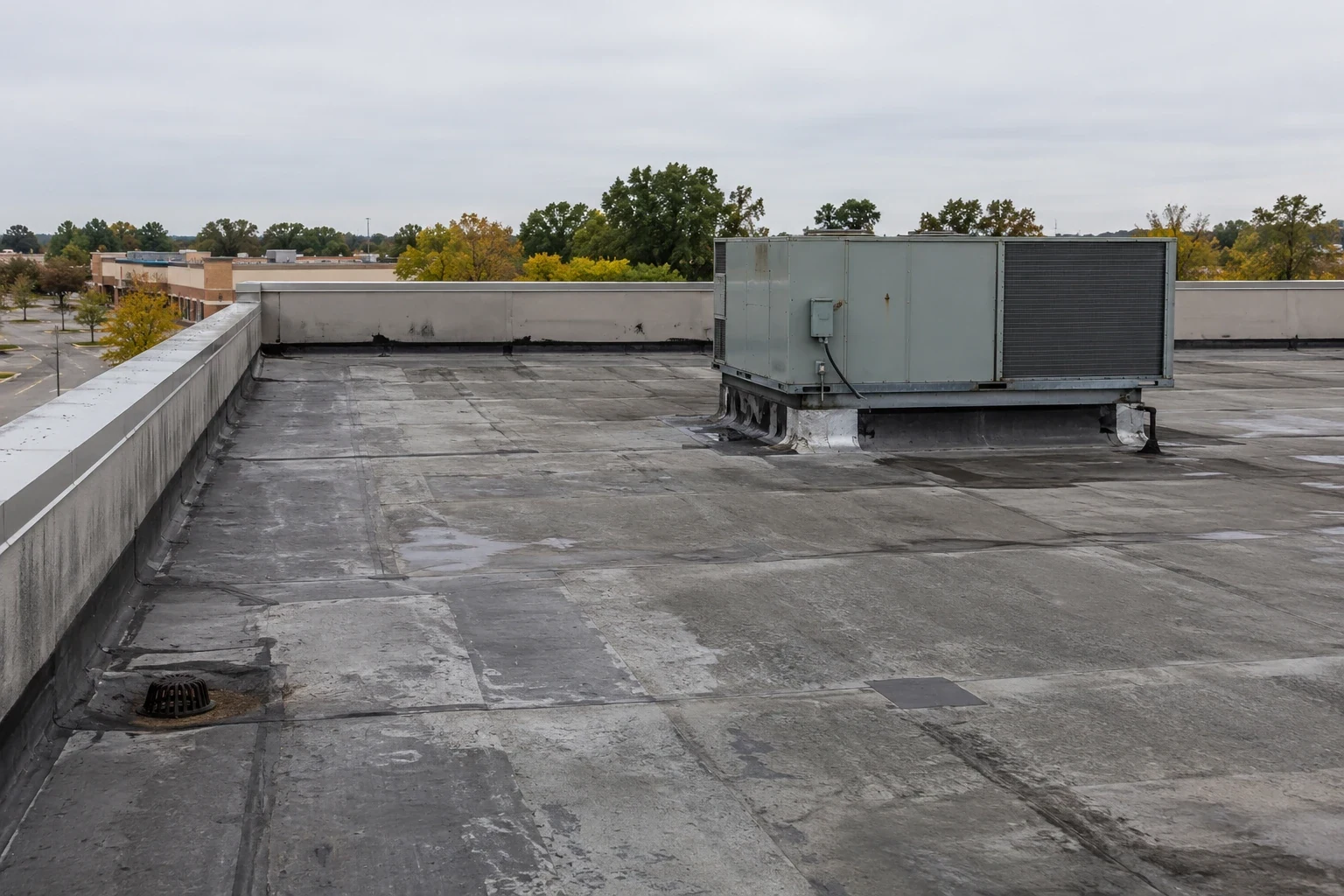
A TPO roof is often installed as a recover, with the new sheet placed over the old roof after a separation layer or cover board goes down. That route saves the tear-off but demands a dry roof. An infrared moisture survey and a few core cuts show whether the insulation can carry a second layer. Where the old roof is wet, the wet material comes out first. A retail or office building along I-470 and US 50 can stay in service during a recover, and the tenant notice and dry-in point are written in the plan before the first roll is opened. The Lee's Summit permit office reviews a project submitted from October 1, 2026 onward under the 2024 I-Codes and an earlier one under the 2018 edition, so we confirm which edition governs the insulation and attachment.
Service life depends on thickness, seam quality, drainage and maintenance. Heat swings between a 108F record high and a -25F record low stress the sheet, so we favor heavier gauges and plan annual inspections that catch seams before water finds them.
In most cases, yes. Small bruises and punctures are patched with a welded TPO cover strip after the area is cleaned. If the hail has broken the sheet across a wide area, a replacement of the damaged sections or a full recover becomes the better choice.
Dirt shows more, and tree debris leaves stains, but cleaning restores most of the brightness. We recommend a wash at set intervals and a check that no walk areas are collecting grime, since dulling reduces the heat benefit.
Standing water that remains after 48 hours deserves attention. TPO tolerates some ponding, but it adds weight and wears seams. A tapered insulation correction, a new drain or a scupper often fixes the cause better than a repair at the low spot.
Hot-air welding makes little odor and no open flame, so it suits occupied suites better than torch or hot asphalt methods. The noise comes from rolls and equipment, which we schedule outside tenant quiet hours when asked.
Send the roof plan, the past repair records and your tenant hours. We will walk the roof, probe the seams and return a written sequence for the TPO scope before any price is set.
Request a Roof Assessment