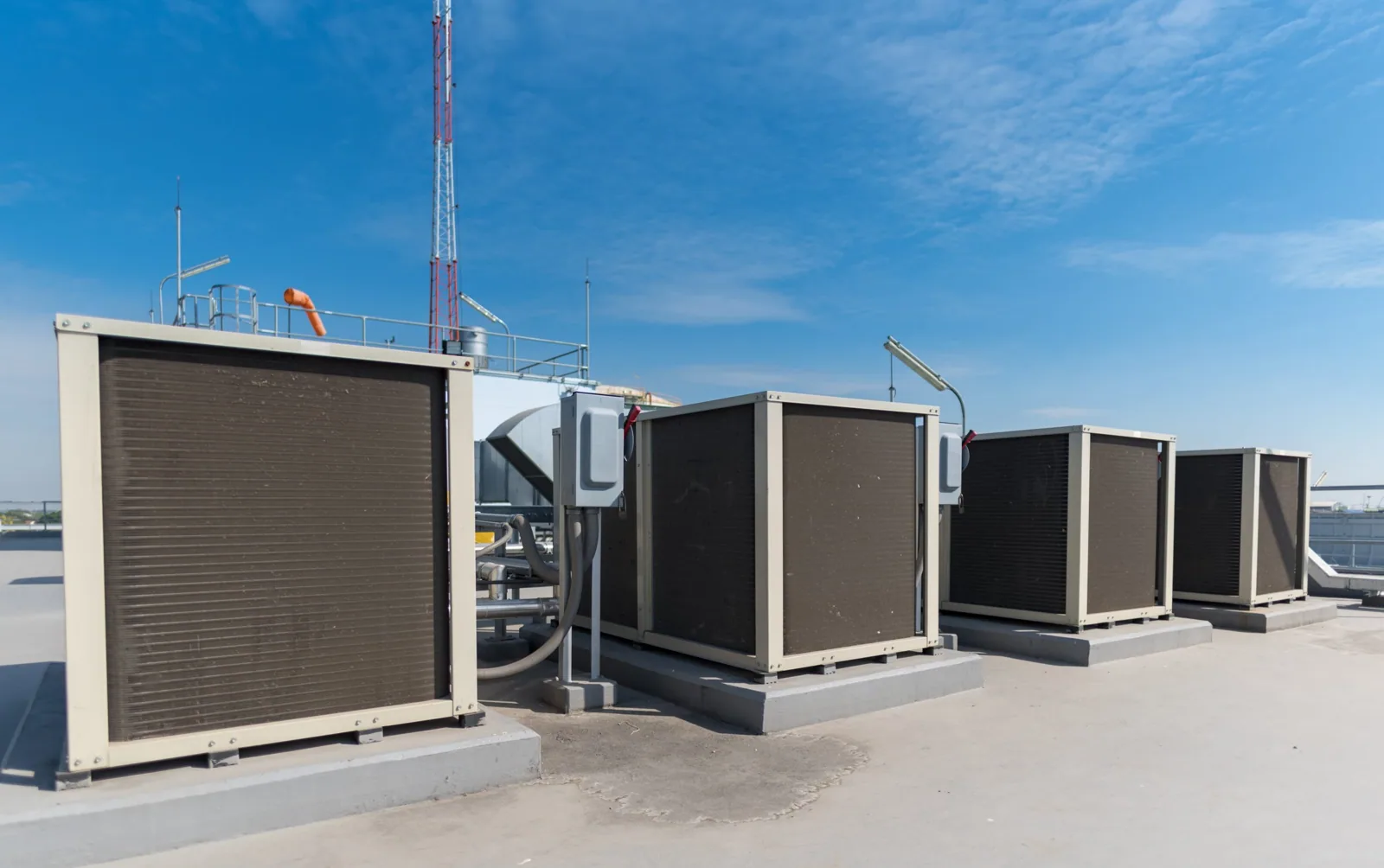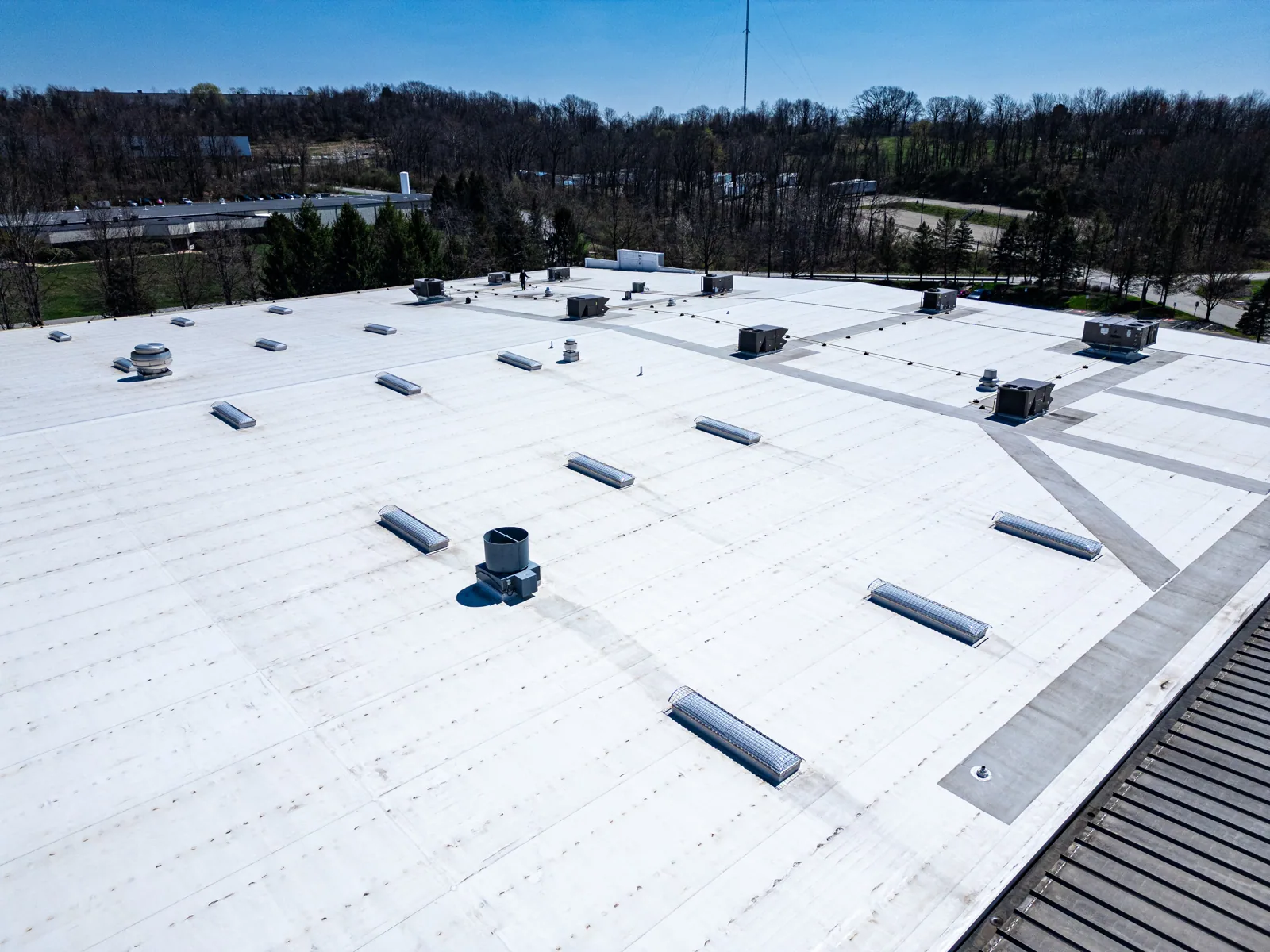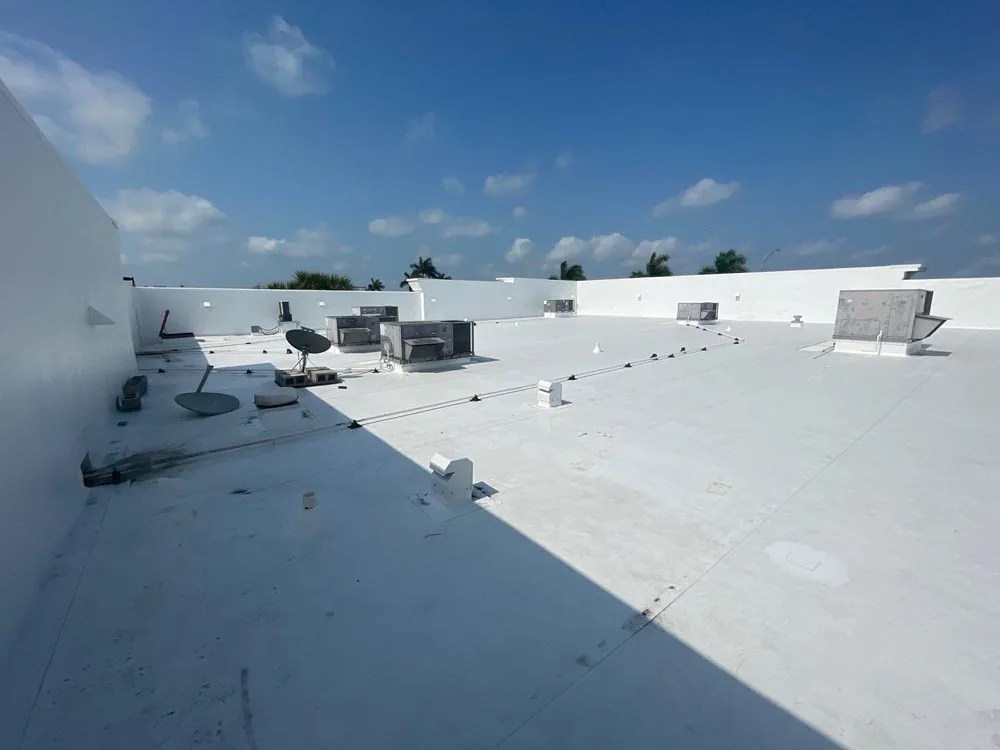

A rooftop unit swap in Lee's Summit, MO is really three events: the tenant notice that goes out ahead of the crane, the hour the old unit leaves its curb, and the hour the new unit lands on one. The roof sits open between those last two. Whatever the curb looks like in that gap decides whether the suite below stays dry. Along the I-470, US 50 and MO 291 corridors, many Lee's Summit commercial properties carry mechanical equipment on curbs, rails or sleepers, and each of those supports is a hole in the roof with a flashing around it. We plan the curb work as its own phase, with its own dry-in point, so the equipment change never leaves a deck exposed overnight, the same discipline we bring to occupied building reroofing.
A curb is a raised frame, usually built of wood or formed metal, that lifts a unit above the roof surface so water runs around it and not under it. The membrane turns up the side of the curb, and a cap or counterflashing sheds water over the top edge. Each piece has a job. The curb height keeps standing water from reaching the opening. The base flashing carries the membrane up past that water line. The cap closes the top. If any one of the three is short, the leak shows up inside the unit's duct opening, often far from where the water entered.
On the first day-one site walk we measure the curb height above the finished roof surface, check the corners where the membrane folds, and look for fasteners that have worked loose. A curb that sat at a proper height when it was built can end up too low after a recover or a second layer of insulation, and that is a reason to rebuild it, not to patch the flashing. Repeated flashing failures at one curb usually point to height.
Equipment replacement rarely brings a new unit with the same footprint as the old one. Base dimensions change, duct openings move a few inches, or the weight rises. When that happens the existing curb either needs an adapter or has to come out. An adapter curb is quicker and keeps the roof penetration where it was, but it adds height and weight at the top of the old flashing. A full curb replacement costs more and takes a longer open period, but it gives a clean new flashing detail.
We ask the mechanical contractor for the dimensioned base drawing before anything is ordered. Then we compare it to the field measurements and mark where the roof opening has to change. If the deck must be cut, the structural question goes to the engineer first, and the roofing steps wait behind it.
Not every item on a roof sits on a curb. Gas lines, condensate lines, conduit and refrigerant runs cross the surface on supports, and those supports are a quiet cause of wear. A rigid support that bears directly on the membrane concentrates foot traffic and weight on one spot, and the membrane under it thins or splits over a few seasons. We replace bare supports with ones that spread the load across a pad of compatible membrane or walkway material, and we check that no pipe rides against a seam.
Equipment on rails or sleepers needs a different eye. The rail should lift the unit clear of the membrane and drain freely, and the roof under it should have a walk pad where technicians step. Where a support has to be fastened through the roof, we use a pitch pocket alternative or a pre-formed boot with a liquid-applied flashing resin, matched to the membrane in place, whether that is TPO membrane or something older. A penetration flashing detail that suits one membrane can fail on another, so the chemistry gets checked before the detail is chosen.
The crane day is the loudest event in the whole job, and it is the one tenants remember. Lifts are planned around dock and entry hours, so a truck is not blocking a loading door at noon. We mark the crane pad, the swing radius and the hoist and staging footprint on the roof plan before the notice goes out, and the notice names the hours, the closed entries and the access route.
For the hospitals and clinics in town, including Saint Luke's East Hospital, a unit shutdown is a facilities event before it is a roofing one. The building engineer sets the windows when air handling can be down, and the roof schedule follows that window. An office occupier that cannot lose air handling during the day pushes curb flashing into early mornings or weekends, which makes the weather hold rule more important.
Lee's Summit sees about 38 inches of precipitation a year and a 108F record high against a record low of -25F. A curb flashing has to survive that spread, and a curb that is opened in March or April has to survive the storm line that may arrive before the work is done. Lee's Summit drew an April 27, 2024 warning from the National Weather Service for 60 mph gusts and penny-size hail, with a specific caution about roof damage.
For that reason, an open curb is never left unprotected. We stage temporary covers and sealed blanking panels at the opening, cut the day's scope to what can be dried in by evening, and set a weather hold that a foreman can call without waiting for approval.
The roof is handed back with a short package for the written roof condition report file: a sketch of every curb and support, the heights measured at turnover, the flashing method used on each, and photographs of the opened and closed condition. The next time an HVAC technician arrives, that package shows where to step and what not to cut. A roof around downtown Lee's Summit may carry restaurant exhaust beside rooftop units, and the grease and heat from the kitchen side call for their own protection at the curb.
Start with the unit's base dimensions. When the replacement matches the old footprint and the curb is sound and high enough, the same curb can stay. When the base differs, we either set an adapter curb or rebuild the original, depending on the flashing condition and how much height the adapter would add.
Plan on the crane hour and the hours on either side of it. We stage the curb flashing materials and blanking panels before the old unit is lifted, so the opening is closed as soon as the unit is out, and the roof is dried in again before the crew leaves for the day.
The turnover photographs answer most of it. If the flashing was sound at turnover and torn at the next visit, the record shows the change. We repair it either way, and the property manager can take the photographs to the tenant or the service company that caused the damage.
Yes, in many cases. A curb extension raises the frame to keep its height above the new surface, and the flashing is rebuilt over it. We check that the unit's weight and its duct connections can handle the extra height before the extension is ordered.
The crew closes every open curb with sealed panels and stops opening new ones. Work that cannot be closed is not started that morning. A warning like the April 2024 storm line in Lee's Summit is exactly why the plan carries a hold rule written in advance.
Send the building list, the equipment schedule and the tenant hours. We will walk the roof with the property manager and return a written sequence for each curb before any scope is priced.
Request a Roof Assessment