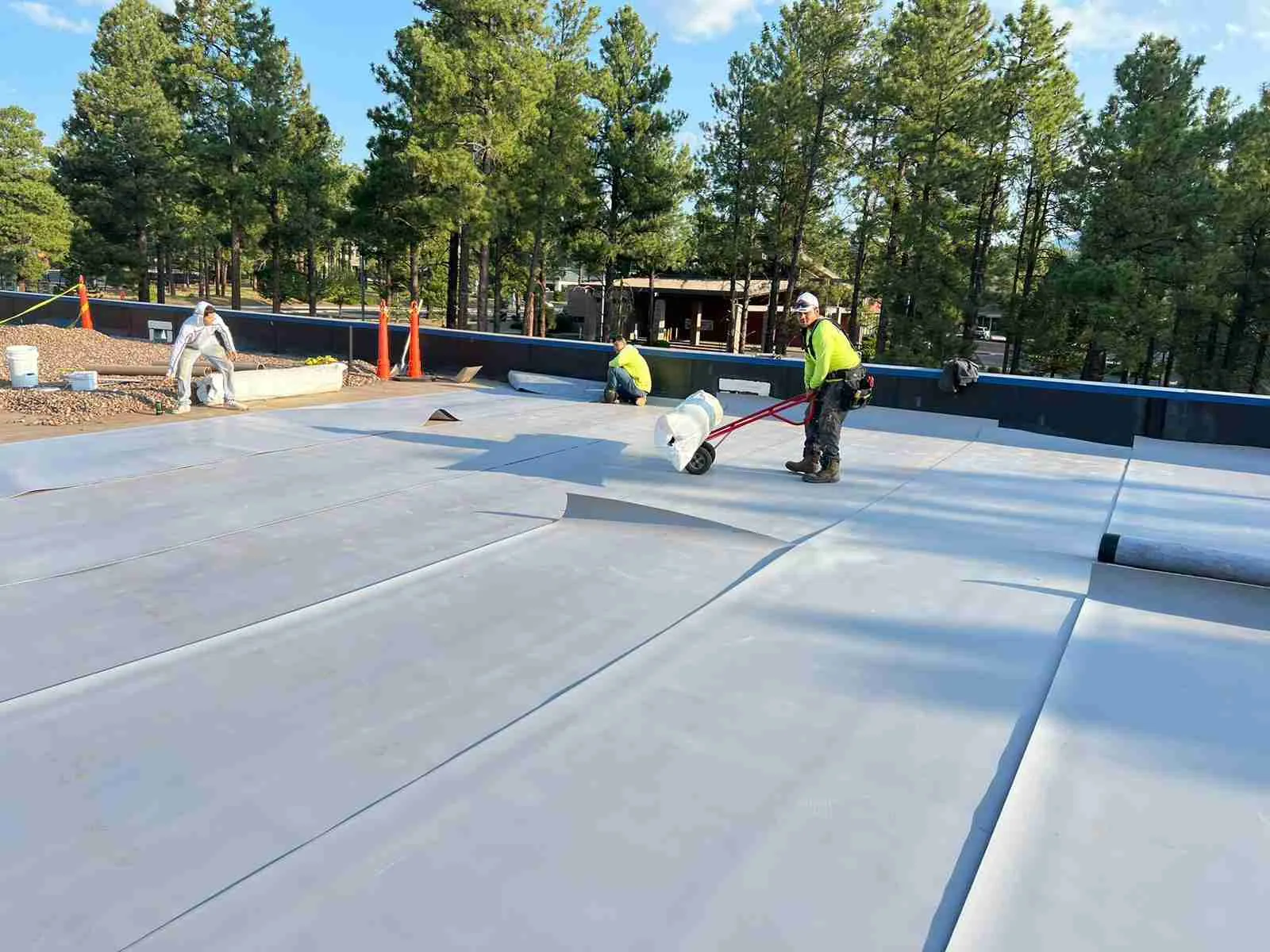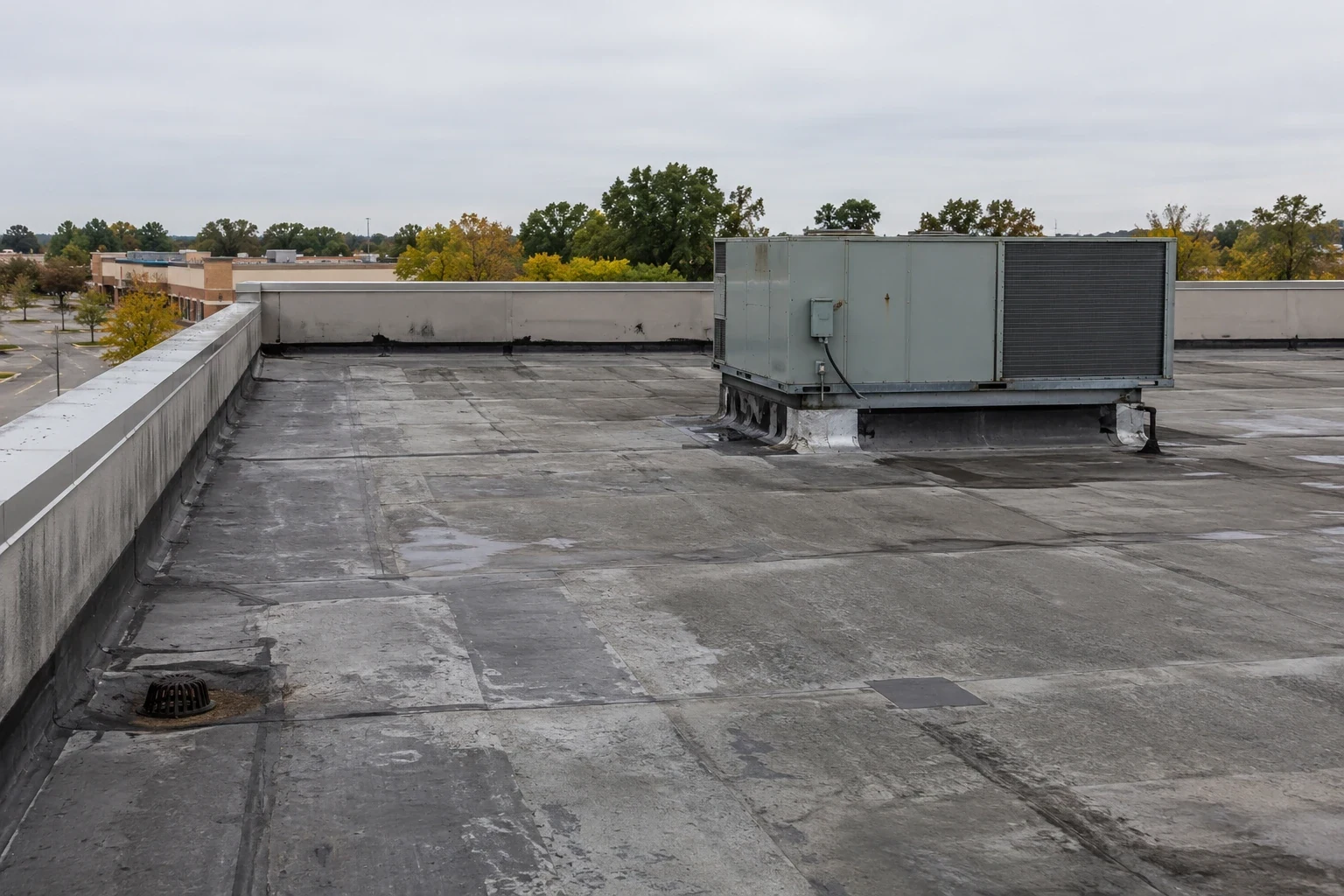

The loading door cannot be blocked at noon, so on a Carlisle SynTec membrane job our crew arrives at dawn and the roll goes out before the first delivery truck backs in. That small scheduling fact shapes a single-ply job more than any product data sheet. Carlisle SynTec makes single-ply membranes in three families: TPO, EPDM and PVC, with the insulation, fasteners, adhesives and flashing accessories that go with them. We install and repair those systems on occupied retail, office and industrial roofs, and we write the sequence before we write the scope.
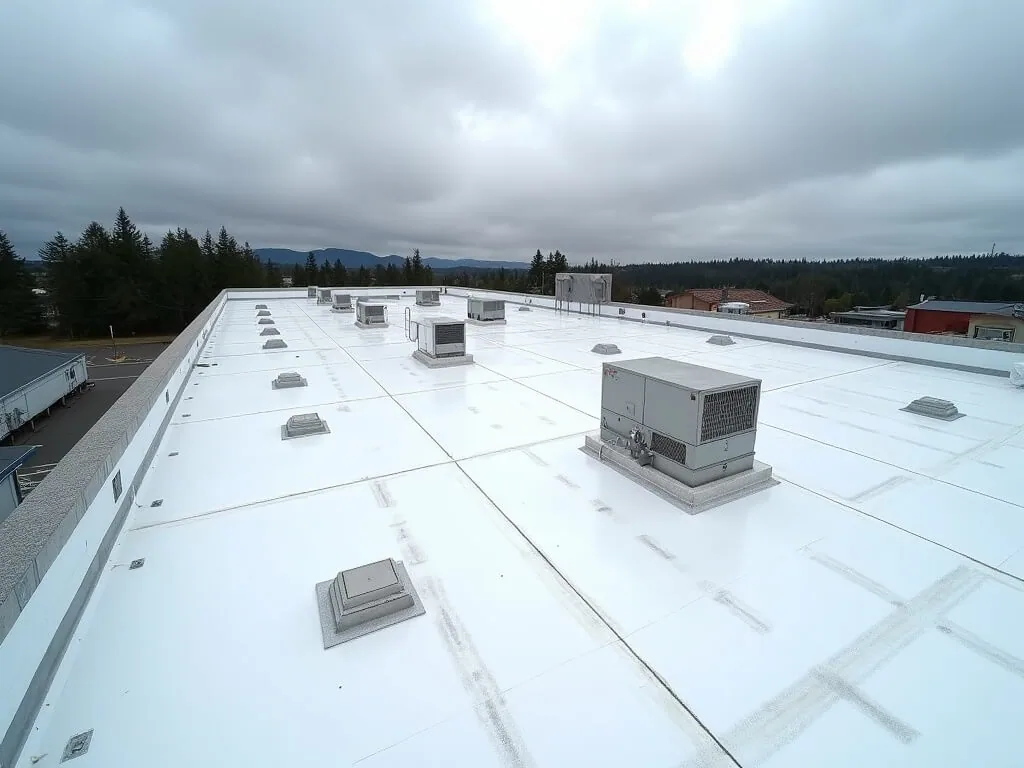
Across the shopping centers near I-470 and US 50, single-ply is the usual answer for a broad, low-slope roof with many rooftop units.
Single-ply is a family name, not one product. TPO is a heat-weldable thermoplastic that is usually white and reflective. EPDM is a cured rubber sheet that is black or white, joined with tape or adhesive at the seams. PVC is a heat-weldable thermoplastic with a plasticizer package and good resistance to grease and chemicals. Carlisle SynTec sells all three, with Sure-Weld as its TPO line.
The difference shows up in the repair. A thermoplastic patch welds to a clean thermoplastic roof with hot air. An EPDM patch is a tape or adhesive job and depends on a dry, primed surface. We identify which membrane we are looking at by sample before choosing a method, because a patch that fits one family does nothing on another. Each family fails differently: EPDM roofing loses its seam tape and flashing adhesion, while PVC roofing stiffens at cold terminations.
Lee's Summit has retail centers such as Summit Woods Crossing and Summit Fair, and any retail roof raises the same staging question: customers and delivery trucks use the frontage that a roofing crew also needs. Before a single-ply replacement begins, we agree on the hoist position, the material laydown area and the dock hours that must stay clear. Tenant notices go to each suite with the work window, the noise windows and the roof hatch locations.
Where a retail strip includes a restaurant or grocer, kitchen and refrigeration exhaust runs through the day. Membrane work around those fans is planned so grease and heat do not contaminate seams, and so the fan curbs are flashed with the same care as the walls. The exposure also affects the choice of shopping center roofing material, since PVC resists grease better than most.
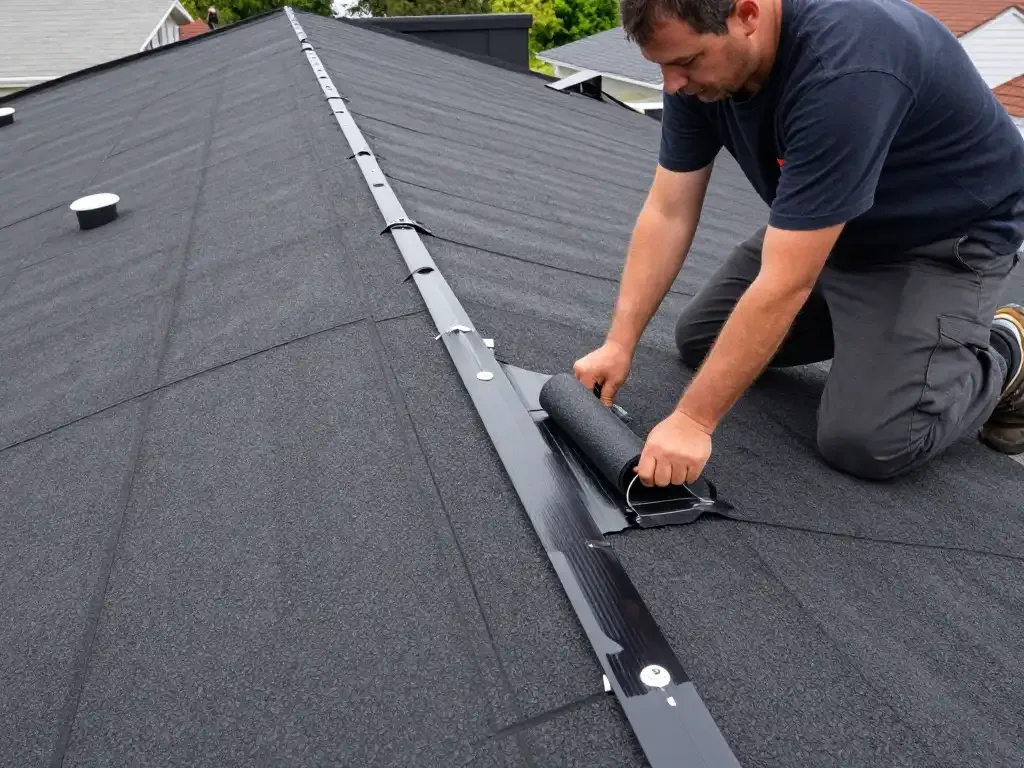
On a single-ply roof the seams are the working parts. A weld that was made too cool or over dust looks fine from the walkway and opens on a cold morning. We probe every seam with a tool, mark the open ones with a paint stick and record them against the roof drawing. Repeated failures along one line usually point to deck movement or a missing fastener row, and those get fixed before the membrane is patched.
Attachment is a separate question. A mechanically attached system uses plates and fasteners at the laps, a fully adhered system is bonded to the substrate, and a ballasted system relies on weight. Each has a wind-uplift rating that has to match the building's height and exposure. We read those ratings from the manufacturer's published details and compare them with the insulation and deck we find, before specifying the attachment pattern.
Lee's Summit averages only about 4.5 inches of snow a year, which makes winter an easy season to overlook. The 2002 ice storm, which cut power for days or weeks to hundreds of thousands of Kansas City residents, is a better reminder of what freezing weather does to a low-slope roof: ice blocks drains, meltwater backs up at scuppers and ponding persists on single-ply for days.
Single-ply membranes tolerate cold but they cannot be welded or glued in it. If the January high is 39F, adhesives set slowly and weld temperatures are hard to hold, so permanent repairs wait for a mild day while temporary measures hold. Our snow and ice roof repair work closes open seams and flashing in the cold with temporary seals, and the permanent fix is scheduled on the turnover list.
A single-ply roof reaches a decision point when repairs become frequent. If the insulation is dry and the deck is sound, a new membrane can be installed over the old one as a recover overlay, which avoids tear-off debris above working tenants. If a moisture survey finds wet insulation across a broad area, replacement is usually the better value, since a recover over wet material traps the problem.
We lay out all three options with the same information: photographs, moisture findings, likely tenant disruption and the effect on the interior. For EPDM roofs that are aging but dry, a coating is sometimes a fourth path. The owner decides with a written report in hand, not a sales pitch.
When the roof is dry and the punch list is closed, the property manager receives the turnover package: product data, the roof drawing with opened and closed areas, photographs of each penetration and a list of what the next walk should check. Warranty terms are set by the manufacturer, and they typically depend on the installation matching published details and on records that show it did.
Records also pay off at the next owner. A buyer's due diligence roof survey reads faster against a clean file, and a lender asking about remaining roof life gets a straight answer. When a tie-in meets a Versico or GAF membrane from an earlier project, the same compatibility test applies.
Restaurants push the answer toward PVC near exhaust fans, since grease attacks some TPO formulations over time. Away from the fans, TPO is often lighter on the budget and just as reflective. A split roof is possible, with the transition detailed so water cannot track between the two.
Start times follow the tenant notice, not the crew's preference. We set dock hours, hatch access and loud work windows in writing before day one, and a tenant with a sensitive schedule can be moved to a quieter phase of the roof.
It will bury it. A recover over wet insulation traps moisture, which then spreads and softens the deck. An infrared scan and core cuts are done first. Dry findings support the recover, and wet findings move the scope toward partial or full replacement.
Usually nothing. Seam failures show as a stain on the ceiling after a heavy rain, or as ponding that lingers near a lap. On the roof, we find them by probing every seam and by looking for ridged or lifted edges at walls and curbs.
Yes, and March is a sensible month for it. Seams and flashing repaired before April are in place when a line of storms like the one warned of on April 27, 2024 comes through. Larger replacements are started when forecasts allow a dry-in each evening.
Share the building list, the dock hours and any leak reports. We will walk the roof, identify the membrane in place and return a written sequence plan before any scope is priced.
Request a Roof Assessment